Varta’s Insolvency: A Cautionary Tale of Battery Sector Overreach
How a 139-year-old German battery pioneer collapsed despite booming demand for energy storage and e-mobility, and what investors should learn.
How does a company with a 139-year legacy, batteries on the Moon, and a front-row seat to the biggest energy transition since the steam engine end up filing for insolvency? That’s the question investors, engineers, and baffled Germans are asking as Varta, the Swabian battery icon, crumbles.
The short answer isn’t “China is cheaper.” That’s the lazy version. The uncomfortable truth involves hubris, a single-customer dependency that would make a financial advisor weep, and a management team that mistook a good decade for a permanent birthright.
Let’s dig into what actually happened, why it matters beyond one company’s misfortune, and what you should take from this mess if you’re investing in German tech or just trying to make sense of the headlines.
The AirPods Trap: When One Customer Owns Your Future
Here’s the part that reads like a business school case study gone wrong. Varta wasn’t a struggling also-ran. Around 2017-2019, the company was riding high, and the reason was sitting in millions of ears worldwide: Apple’s AirPods.
Varta had essentially cornered the market for the tiny lithium-ion button cells inside those wireless earbuds. Apple was hooked, revenue was soaring, and the stock price went vertical. Management looked at the order book, saw dollar signs (or rather, euro signs), and made a bet that would eventually sink the ship: they scaled up production capacity in Germany specifically to serve Cupertino’s appetite.
Here’s what they apparently missed. Apple doesn’t do loyalty. Apple does supply chain optimization. When Chinese manufacturers like EVE Energy and Sunwoda demonstrated they could produce comparable button cells at a fraction of the cost, the switch flipped. Apple transitioned its AirPods battery sourcing to Chinese suppliers, and Varta was left with gleaming new factories, massive fixed costs, and no anchor customer.
The Nördlingen plant, built to serve Apple, is slated to close this autumn with around 350 jobs disappearing. The lesson here is brutal but simple: if more than 50% of your revenue depends on one customer, you don’t have a business. You have a lease.
The V4Drive Gamble: Chasing Giants Without the Capital
But the AirPods loss alone might not have been terminal. What sealed Varta’s fate was the company’s ill-fated attempt to break into the electric vehicle battery market with its V4Drive division.
This is where the “overreach” part of our title really kicks in.
Varta’s management watched the EV revolution and decided they needed a piece of it. The problem? Competing in automotive battery cells means going head-to-head with CATL and BYD, Chinese giants with state backing, virtually unlimited capital, and production scales measured in hundreds of gigawatt-hours.
Varta’s response was… to try anyway, hoping Porsche would be their knight in shining armor. Porsche did invest, becoming the anchor customer for V4Drive cells designed for high-performance hybrid vehicles. But as one observer noted, the company simply lacked the capital and scale to mass-produce at competitive prices. Porsche, ever the pragmatist, eventually picked up the pieces of V4Drive for a relative pittance, while Varta was left holding the bag.
It’s a classic German industrial tragedy: excellent engineering, noble intentions, and absolutely no ability to compete on cost against a competitor that can flood the market with subsidized production.
The Numbers Tell the Story
Let’s look at the cold, hard arithmetic that forced Varta to file for insolvency at the Amtsgericht (local court) in Stuttgart on July 24, 2026.
Four entities, the parent company Varta AG, Varta Microbattery, Varta Micro Production, and Varta Storage, went into preliminary insolvency proceedings. These four units employ around 2,300 people and generated roughly €800 million in revenue in 2024. At first glance, that doesn’t look like a failing company.
But here’s what the balance sheet revealed: a “structural financing gap” after shareholders Porsche and Austrian entrepreneur Michael Tojner declined to inject fresh capital. This followed a previous rescue in 2024, where a restructuring procedure had already wiped out old shareholders and forced creditors to take haircuts. The company had been living on borrowed time and borrowed money.
The insult? The profitable consumer battery division, the one making those yellow-and-blue AA batteries you’ll find in every German household’s kitchen drawer, had been carved out before the insolvency filing. It will survive, now controlled by a creditor group that includes several foreign hedge funds and Deutsche Bank.
Yes, you read that right. The hedge funds walked away with the crown jewels, and the company’s technological core, including those sodium-ion batteries touted as the future, was left to rot.

The Politics of Letting Varta Die
Here’s where the story gets spicy. Varta isn’t just any company. It’s a defense contractor. The consumer division produces specialty batteries for naval mines and has projects with drone manufacturers. That’s why the Bundeswirtschaftsministerium (Federal Ministry of Economics) has now stepped into the investment review process, examining whether a sale to foreign investors could compromise Germany’s “public order or security.”
The ministry’s scrutiny isn’t just bureaucratic theater. Germany has watched its battery sector get hollowed out while Asia dominates the supply chain. Varta is essentially the last major German battery player with meaningful technological know-how, including expertise in sodium-ion storage, which Europe loves to discuss at conferences but rarely produces at scale.
The irony is thick enough to spread on bread. Back in 2020, then-Economics Minister Peter Altmaier personally promised Varta subsidies to become Germany’s “battery champion.” Around €137 million flowed from federal and state funding pots. The result? Eight years later, the company is in pieces, and the government is scrambling to figure out whether national security depends on a Swabian factory making batteries for naval mines.
As one commentator put it, the “system relevance” check is the German state’s way of discovering it has a strategic dependency problem, after it’s already too late to solve it cheaply.
What Investors Should Actually Learn from This Disaster
If you’re reading this as someone with money in German stocks, a Depo (portfolio) at any of the major brokers, or even just as a bystander watching the drama unfold, there are some uncomfortable takeaways.
First: Technological excellence is not a business model. Varta had world-class engineering. Apollo 11’s astronauts used Varta batteries in their Hasselblad cameras on the Moon in 1969. That’s an incredible brand story. It didn’t pay the bills when Apple walked away and Chinese competitors undercut prices by 30-40%.
Second: The German industrial playbook has a blind spot. Germany’s manufacturing strength was built on verticals like automotive, chemical, and mechanical engineering, where quality premiums could justify higher costs. Battery cell production is a commodity game. When the product becomes standardized, cost wins, and China’s combination of cheap energy, massive scale, and state coordination simply can’t be beaten by a mid-sized Swabian company playing by normal market rules.
Third: Watch for single-customer risk in your own investments. Whether you’re looking at German Mittelstand stocks, tech startups, or that one supplier whose revenue is concentrated in a single auto manufacturer, concentration is the killer. The German economy is littered with companies that had one great customer and believed it would last forever.
Fourth: Beware the “future sector” narrative. Everyone knew batteries were the future. The demand for energy storage and e-mobility is objectively exploding. Yet Varta still managed to go bankrupt in the middle of the boom. The lesson? A rising tide doesn’t lift every boat when some boats have holes in their hulls.
If you’re the type who likes to think about investor security and risk in financial platforms, this story should reinforce that the platform is never the real risk, the underlying business is. Your broker account might be secure, but the company you’re buying can still implode.
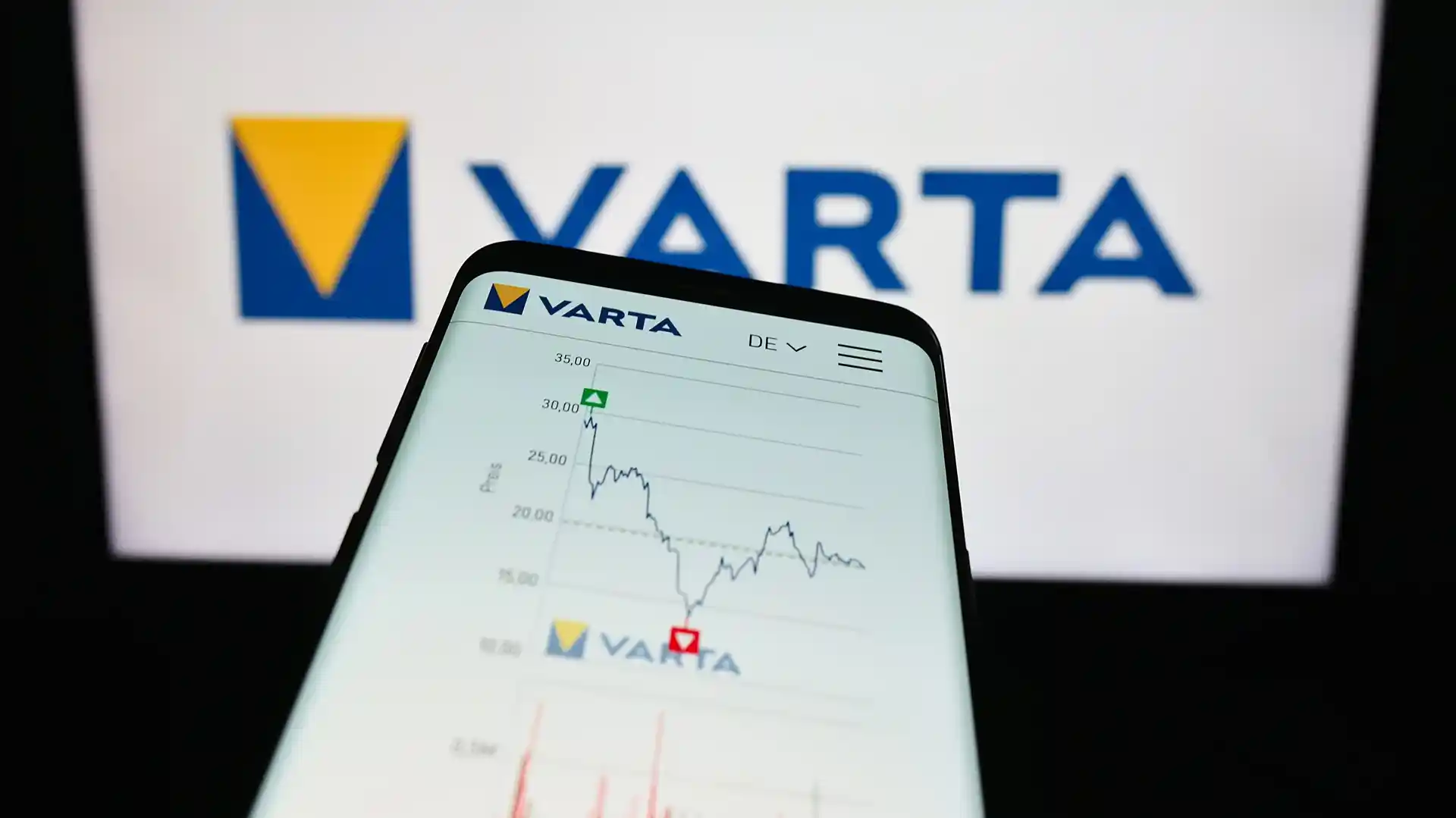
And if you’re tempted by high-risk financial products leading to downfall because you want to “play the bounce” in distressed German equities, consider this: Varta shares have already burned retail investors once in 2024, wiping out their value in the restructuring. It’s doing it again now. Chart patterns don’t care about your thesis.
The Collateral Damage: 3,260 Lives Upended
Behind the financial analysis, there are real people. Varta employs around 3,260 people across the group, with roughly 2,300 in the insolvent units. The Ellwangen headquarters sits in rural Baden-Württemberg, where jobs don’t grow on trees.
The preliminary insolvency administrator, Tobias Wahl, is putting on a brave face. He’s talking about “an encouragingly large number of interested parties” and the company’s strong technical competence and global customer relationships. He’s hoping for a structured sales process and a “sustainable restructuring solution.”
But the grim reality is that German industrial insolvencies of this scale rarely end with everyone employed. Some divisions will be sold, others will be shut, and the “technical competence” Wahl praises will be scattered to whichever private equity firm values a sodium-ion patent portfolio most highly.
Meanwhile, the government is examining whether a foreign takeover of Varta’s military battery production would be acceptable under the Außenwirtschaftsverordnung (Foreign Trade and Payments Ordinance). It’s a legitimate national security question. It’s also a sad commentary on how far Germany’s once-proud battery industry has fallen.

The Bigger Picture: Germany’s Industrial Strategy Needs a Reboot
Here’s the part that should worry anyone living in Germany, not just Varta shareholders.
The pattern isn’t new. German solar manufacturers were decimated by Chinese competition in the 2010s. The auto industry is facing existential threats from Chinese EV makers. Chemical companies are struggling with energy costs. And now, the battery sector, supposed to be a cornerstone of the green transformation, is collapsing.
The excuses are always the same: China is cheaper, China subsidizes unfairly, China has scale. And there’s truth there. But the deeper problem is that German industrial policy has been reactive, not strategic. Altmaier tossed €137 million at Varta in 2020 and called it a day. No sustained strategy, no focus on where Germany could actually compete, no acceptance that commodity production might not be the right battlefield.
The cost of financial caution and market timing applies to nations too. Sitting on the sidelines while the world industrializes your core sectors isn’t prudence, it’s passive decline.
A Modest Proposal: Stop Trying to Compete on Cost
If I get one wish, it’s that German industrial leaders stop pretending they can out-China China on mass production. They can’t. The window for that closed a decade ago, and it’s not coming back.
What Germany can do is specialize in high-value, high-performance applications where quality and reliability matter more than unit cost. That’s where Varta actually succeeded, in specialty batteries for hearing aids, medical devices, and yes, even military applications. The consumer household battery business survived precisely because consumers are willing to pay 20 cents more for a brand they trust when the remote control needs juice.
The company’s error wasn’t building batteries. It was building commodity-scale production capacity for a customer who would always leave for a cheaper supplier. The management team confused Apple’s temporary dependence with genuine competitive advantage.
For the rest of us, the takeaway is straightforward. Demand for a product isn’t a moat. Technology isn’t a moat. Brand loyalty in consumer goods is a weak moat. The only real moats are cost advantages, network effects, switching costs, and regulatory barriers. Varta had none of those in its core growth business, and it paid the price.
The Bottom Line
Varta’s insolvency is a cautionary tale in the most literal sense. It warns us that even companies standing at the center of the world’s most promising megatrends can destroy themselves through strategic arrogance and operational complacency.
The batteries in your AirPods might now come from China. The batteries in your remote control will still say Varta for the foreseeable future. And the company behind both icons is now an object lesson in how quickly technological leadership can evaporate when you stop asking yourself a simple question: What happens if our biggest customer walks away?
If you’re an investor in German tech, a professional watching the industrial landscape, or just someone trying to understand why the country that won the 2014 World Cup is struggling to win the battery race, this story is worth remembering.
The future of energy storage is bright. The future of unprepared companies trying to ride that wave is not.
And if you see “system relevance” checks and government bailout talk in the news for other sectors, remember Varta. The state will always show up to ask questions. Whether it shows up to actually help, before it’s too late, is a different story entirely.