The Siren Song of the Hebel (Leverage)
It starts innocently enough. You see a chart, a trend line, a YouTube guru explaining a "set-up." You’re not gambling, you’re strategizing. You open your sleek, German broker app, maybe Scalable Capital or Trade Republic. The interface is clean, the process frictionless. Buying a regular stock feels boring, but right there, next to it, is the option for a Hebelzertifikat (Leverage Certificate) or CFD.
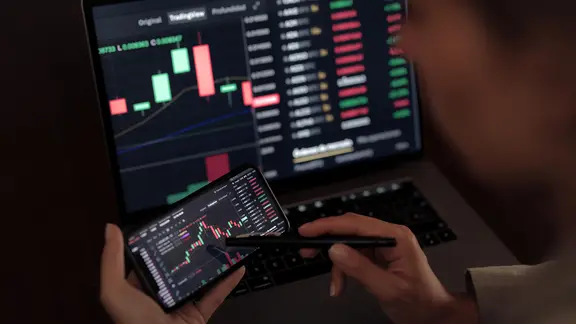
A small sum can control a large position. A 2% move in the underlying asset becomes a 20% or 50% move in your favor. This is the core illusion. As the article from Head Topics notes, "the leverage multiplies your profits if your trading decision was correct… but also the losses, should your market assessment have been incorrect."
The problem is that in the short-term, market movement is noise, not signal. You are not predicting a trend, you are betting on the minute-to-minute volatility of a system where professional algorithms execute orders in microseconds. You are bringing a butter knife to a drone strike.
Meet "dirtydarry": A €2,137 Cautionary Tale
Consider the Reddit user we met earlier who decided to test out leveraged products on Scalable at the start of the year. They used TradingView, set stop-losses (SLs), and had a defined max loss. Five months later, they posted their "misserfolg" (failure). They blew past their €2,000 limit and tapped out.
Their conclusion? "Scalable is absolutely not suitable for this. Absolutely do not invest in leveraged derivatives there."
"I dare say it wasn’t Scalable’s fault."
This reply hit the nail on the head. The platform is just the conduit. The flaw was the premise. As another user put it, using chart analysis for short-term trading has "faktisch nicht die geringste Aussagekraft" (factually not the slightest predictive power). It’s "like horoscopes."
The Turning Point
One user reflected deeply: "This is the pivotal moment most day traders eventually face: the shift from trying to outsmart the market to simply participating in it."
The path to building real wealth from Germany doesn’t run through late-night CFD charts, it runs through the steady, automated drip of an ETF-Sparplan (ETF savings plan).
The Finanzamt’s (Tax Office’s) Brutal Take
Let’s say, against the odds, you do win. You catch a wave, ride a 10x Hebel (leverage), and turn €1,000 into €5,000. Surely that’s a win? Not so fast. This is where Germany’s love for regulation introduces a special form of torment.
For tax purposes, CFDs and other leveraged derivatives are classified as Termingeschäfte (futures transactions). Since 2021, a particularly nasty rule in §20 Abs. 6 Satz 5 EStG (Income Tax Law) applies. Your Gewinne (profits) and Verluste (losses) from these products cannot be simply netted off in the same year.
Your actual economic profit is €10,000. Logical, right? Not to the Finanzamt.
The Psychological Toll: It’s Not Investing, It’s a Behavioral Loop
A chilling report from NDR Schleswig-Holstein interviewed experts who frame the problem not just in euros, but in psychology. Daytrading, especially with leverage, activates the same reward pathways as gambling. "It’s constantly moving and you can constantly do something", explains Ulrich Schmidt, a behavioral economist at the Kiel Institute for the World Economy. This dynamic strongly appeals to the brain’s reward system.
Suchtberatungsstelle (addiction counseling center) advisor Judith Schaum from Bad Segeberg reports seeing clients where high-stakes, rapid trading leads to a loss of connection to the real value of money. Michael Grossnick from a Kiel debt counselling centre adds that debts of €50,000 from daytrading are "not uncommon."
The problem is compounded because victims often have good jobs, banks readily grant them €10,000+ loans, which they then pour back into the cycle.
Your Actual Escape Route: The German Way
1. Swap Hebel for Sparplan
The single most effective move is to automate your investing. Set up a monthly ETF-Sparplan on a global, diversified ETF like the Vanguard FTSE All-World (VWCE) or a MSCI World ETF. The broker executes it, you ignore the market noise.
2. Understand What You’re Buying
An ETF is a basket. A Hebelprodukt is a bet. One is a tool for ownership, the other is a tool for speculation. Before buying any financial product, ask: "Do I own a share of a company/country/commodity, or do I own a contract about its price movement?"
3. Define Your Role
Are you an investor or a trader? An investor funds economic growth over decades and participates in its rewards. A trader is trying to outwit other participants in a zero-sum game. Germany’s pension system is built for investors. Pick your lane and commit.
4. Tax Optimization is Your Friend
Use your €1,000 Sparerpauschbetrag (€2,000 if jointly assessed). Hold ETFs for longer than one year to benefit from the Spekulationsfrist (speculation period) and potentially tax-free gains. This boring, administrative work yields more certainty than any "sure thing" chart pattern.
The Bottom Line
The German financial landscape offers two paths. One is lit by the neon glow of a trading terminal, promising explosive riches but statistically leading to loss, debt, and a grueling psychological battle. The other is lit by the dull, reliable light of a Sparplan confirmation email, leading over decades to financial security.
You don’t need to outsmart the DAX. You just need to own a tiny, diversified piece of the global economy, automatically, for a very long time. The day trader staring at the screen at 3 AM is fighting physics, psychology, taxation, and probability.
The person whose ETF purchase went through at 10 AM and who hasn’t checked the app since is winning. Choose your camp wisely.