
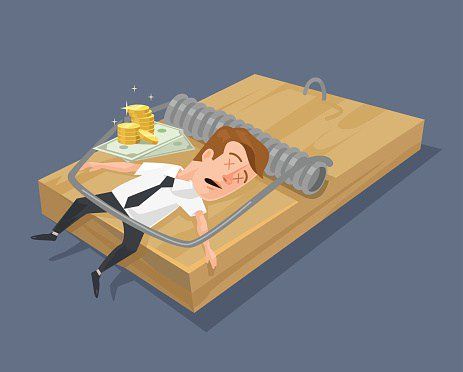
You know the feeling. You’re scrolling through your broker app at 2 a.m., watching the DAX dance near 25,000 points while your cash sits in a Tagesgeldkonto (day savings account) earning 2.3% interest. Your brain is screaming two completely contradictory things at the same time:
“Buy now before you miss everything forever!”
“Are you insane? Wars, tariffs, a looming recession, this thing is about to implode!”
Welcome to the investor’s version of standing on a train platform while the doors keep closing in front of you. The train is clearly still running, but every fiber of your being tells you it’s about to derail. So you stand there, frozen, watching the departure board tick higher and higher.
I’m not here to tell you “time in the market beats timing the market” for the thousandth time. You’ve heard that. You probably repeat it to yourself in the mirror while brushing your teeth. The problem isn’t that you don’t know the theory, it’s that your brain’s fear circuitry is currently winning the war against your rational investment plan.
Let’s dig into why this feels so impossible, and more importantly, what you can actually do about it.
The Psychological Torture Chamber of the Waiting Investor
There’s a specific flavor of agony that comes with sitting on cash during a bull market. It’s not just FOMO (Fear Of Missing Out). It’s deeper than that. It’s the slow realization that your careful prudence is slowly bleeding value.
The German investor community on r/Finanzen has a name for people like this: “die verzweifelten Bären” (desperate bears). These are investors who intellectually know that ETFs are the right call, who’ve read all the Finanzfluss books, who have their Sparpläne (savings plans) ready to go, but who just can’t pull the trigger.
The internal monologue goes something like this:
“The market keeps hitting all-time highs. That can’t be sustainable. There’s a war going on. Trump is threatening Taiwan. Oil prices are spiking. None of this makes sense. The moment I buy, gravity will finally remember it exists and smash everything down.”
This isn’t irrational. It sounds perfectly rational. The problem is that this exact thought pattern has been the most expensive mistake for investors over the last 15 years.

Consider this: the S&P 500 has hit new all-time highs more than 100 times since 2016. Each time, there was a perfectly reasonable reason to be scared. Brexit. Trump’s election. Trade wars. COVID. Inflation. Ukraine. Gaza. Taiwan tensions. Each time, the market recovered and pushed higher.
As one seasoned investor put it, summing up the eternal dilemma: “Bears sound smart, bulls make money.”
The Data That Will Make You Uncomfortable
Let’s look at something that might shift your perspective. The statement “the market is at an all-time high (ATH)” is often used as a warning sign. But mathematically, a market that consistently rises must spend most of its time near ATHs.
Actually, this claim gets debated. Some argue that if you look at the Shiller S&P 500 from 1871-2023 with a 1% tolerance, the market sits below its ATH about 90% of the time. But the critical distinction is this: that includes decades of flat or sideways markets. In a secular bull market, which we’ve arguably been in since 2009, the market is near its highs with surprising frequency.
The real question isn’t “Is the market at an ATH?” The real question is “Where will this same index be in 10 years?”
Historically, if you invested at an ATH, your 10-year returns were still positive in the vast majority of cases. The exceptions were the peak before the Great Depression and the peak before the Dotcom crash, both of which required patience but eventually recovered.
Why “Waiting for the Crash” Is a Dangerous Strategy
Here’s what nobody tells you about waiting for a market correction: even if you nail the timing, you might still lose.
Consider the cost of inaction. If you sat on €50,000 in cash from January 2023 to May 2026, you might have earned around 2-3% interest per year. Meanwhile, the MSCI World returned roughly 40-50% over that same period.
That’s not a “crash protection strategy.” That’s a “destroying your purchasing power strategy.”
The cost of staying on the sidelines is well documented, it’s the cost of staying on the sidelines with cash in a savings account that silently erodes your wealth.
But let’s be honest, you know this. The real issue is that you’re terrified of being the person who buys the top right before a 50% crash. The fear of being that guy overrides the rational math of compounding returns.
The August 2015 Flash Crash: A Cautionary Tale (But Not the One You Think)
You may have heard about the August 24, 2015 flash crash, where some ETFs dropped 50% while the underlying index only fell 5%. This sounds terrifying, and it is, but it’s also a perfect example of why panic-driven decisions are the real enemy.
During that crash, market makers withdrew liquidity. Individual stocks were halted. ETF prices detached from their net asset value. Investors who had set stop-loss orders got executed at prices that represented a temporary mechanical failure, not a real market valuation.
The ones who survived and thrived were the ones who held steady, or better yet, bought into the chaos.
This is the crucial lesson: markets can act irrationally in the short term, but they tend to reward discipline over decades.
What Actually Happens to ETFs in a Real Crash
The recent analysis of “100% riskant” ETFs makes valid points. Yes, ETFs can create mechanical selling spirals. Yes, if everyone tries to exit simultaneously, liquidity can dry up. Yes, a crash can be exacerbated by passive index strategies.
But here’s what the alarmist analysis glosses over: these risks are almost entirely neutralized by a long enough time horizon.
Let’s look at the actual recovery data:
| Event | Maximum Drawdown | Time to Recovery |
|---|---|---|
| Oil Crisis (1973/74) | -52% | ~7 years |
| Dotcom Crash (2000-2003) | -54% | ~13 years |
| Financial Crisis (2007-2009) | -48% | ~4-5 years |
| COVID Crash (March 2020) | -30% | ~1 year |
The Dotcom recovery took 13 years. That’s brutal if you needed the money in 2003. But if you were investing monthly via a Sparplan, you were buying continuously through the valley, accumulating shares at discount prices that would later compound into significant wealth.
The worst case scenario for a long-term ETF investor isn’t a crash. It’s sitting on cash and missing the recovery.
The Practical Strategy: How to Break the Paralysis
If you’re sitting on cash right now and can’t bring yourself to dump it all into the market at once, I have good news: you don’t have to.
1. The Strategic Cost-Average Approach
Instead of agonizing over the “perfect entry point”, commit to a fixed investment schedule over 6-12 months. This doesn’t optimize your entry, but it does eliminate the paralysis. Every month, a set amount goes in, regardless of the market level. Some months you’ll buy at highs. Some months you might catch a dip. On average, you’ll get a decent price without the emotional torture.
2. The “Core and Explore” Method
Put 70-80% of your cash into a broad market ETF like the MSCI World or FTSE All-World immediately. Yes, now. This establishes your core position. Keep the remaining 20-30% as “dry powder” to deploy during the next 5-10% correction. This way, you’re both invested and prepared for opportunities. It’s a psychological hack that satisfies both sides of your brain.
3. Remember: Market Anxiety Is the Norm, Not the Exception
Every generation of investors has believed “this time is different.” The list of existential threats that markets have shrugged off is almost comical: 9/11, SARS, the Iraq War, the 2008 collapse (which was different, but markets still recovered), Fukushima, Brexit, COVID, Russia-Ukraine, Gaza, the debt ceiling circus…
The market climbs a wall of worry. It always has. It always will.
If you’re worried about how market anxiety can lead to selling low and missing the recovery, you’re not alone. But the solution isn’t to avoid the market, it’s to build a system that accounts for your own psychological weaknesses.
4. Set Up Automation and Walk Away
This is the single most powerful tool for overcoming FOMO and fear: a fully automated Sparplan. Choose your ETF, set the monthly amount, and then stop checking your portfolio. Uninstall the brokerage app for 6 months. Block the financial news sites. Let compound interest do its invisible work while you focus on literally anything else.
The SpaceX IPO Test: When FOMO Distorts Decision-Making
The upcoming SpaceX IPO, potentially the largest in history, is a perfect case study in how FOMO can override rational analysis.
Reports suggest SpaceX is targeting a $2 trillion valuation. Valuation expert Aswath Damodaran estimates fair value closer to $1 trillion. But here’s his warning: “Many analysts have already decided they will buy SpaceX because they believe they can’t afford to be left out. The fear of missing out is large because they’ve seen what happens when they miss such an opportunity.”
Translation: people are willing to ignore a 100% premium because they’re terrified of watching someone else get rich without them.
This is the mirror image of the problem we’re discussing. The same psychological force that keeps you out of the market at ATHs also makes you overpay for hyped IPOs. In both cases, the antidote is the same: a disciplined, rule-based approach that removes emotion from the equation.
What I Actually Think You Should Do
If you’re sitting on cash right now, you’re in good company. Many thoughtful, intelligent investors are in the same position. The market feels detached from reality. Valuations are elevated. Geopolitical risks are real.
But the historical evidence is overwhelming: waiting for the “perfect” entry point is a losing strategy.
The market doesn’t care about your feelings. It doesn’t know that you’re waiting for a 20% correction before committing. It will continue to do what markets do, fluctuate, sometimes violently, but trend upward over the long term.
The only way to win this game is to play it. Not perfectly. Not at the exact bottom. But consistently, over decades.
So here’s my advice, delivered with the blunt honesty of someone who’s been through this cycle before: stop trying to predict the crash. It might come tomorrow. It might come in three years. It might come after a 30% further run-up. Nobody knows.
What you can know is that sitting on cash in a Tagesgeldkonto is a guaranteed path to losing purchasing power. And that’s a risk far more certain than any market correction.
Set up your Sparplan. Automate it. And then go live your life. The market will take care of the rest.
Full disclosure: I hold positions in broad market ETFs and use automated Sparpläne. I’ve been through multiple corrections and bear markets. Each time, my biggest regret was the cash I kept on the sidelines, not the money I had invested during the drawdown.
Additional reading for the curious mind:
– Decoding what a record-high market actually means for buying decisions
– The parallel between an overvalued AI market and the current general market
– The pain of missed investment opportunities due to financial upbringing