
Picture this: You’re sitting in your Berlin apartment, scrolling through your broker app, feeling pretty good about that chunk of cash you’ve parked in a money market fund. It’s earning a respectable 2.5% thanks to the European Central Bank’s interest rate hikes, it’s liquid enough to access anytime, and it’s about as exciting as watching paint dry. Which is exactly the point. Money market funds are supposed to be the financial equivalent of a German train arriving on time, boring, reliable, and always there when you need it.
But what if that train is actually running on tracks that lead straight through a financial swamp? And what if the locomotive powering it is built on a house of cards in London and New York?
Here’s the uncomfortable truth that’s been circulating in German investment circles: the US government’s debt situation has deteriorated to the point where American Treasuries, the supposed bedrock of global finance, are now trading in an environment where the marginal buyer isn’t a patient pension fund or a cautious central bank. It’s a hedge fund running a leveraged trade through London banks. And that has profound implications for your supposedly safe euro-based money market fund.
The 40 Trillion Elephant in the Room
Let’s start with the obvious. The US national debt has crossed the $40 trillion mark, that’s a 40 with twelve zeros, a number so large it’s practically abstract. According to the Bankhaus Metzler, the US Treasury Department is now spending roughly $100 billion per month just on interest payments, with that number trending upward. Recent coverage of the bond market turbulence highlights that 30-year US Treasury yields recently hit their highest levels in 25 years, exceeding 5%.
Here’s where it gets personal for European investors: when those yields started climbing, German 10-year Bund yields (Bundesanleihen) followed suit, reaching 3.25%, the highest level in 15 years. The interconnection between US and European bond markets isn’t a theory, it’s a mathematical certainty.

The Pawn Shop Loop: How Your Safe Fund Actually Works
Now for the part that makes financial advisors uncomfortable. Most people assume a money market fund buys government bonds directly, holds them to maturity, and collects interest. Simple, right? Not anymore.
The reality, as explained in detailed analysis from Andreas Steno Larsen at Real Vision, is far more complex. Many European money market funds, including popular products like the DBX0AN ETF, don’t actually buy bonds directly. Instead, they enter synthetic arrangements with banks.
Here’s the “pawn shop loop” in plain terms:
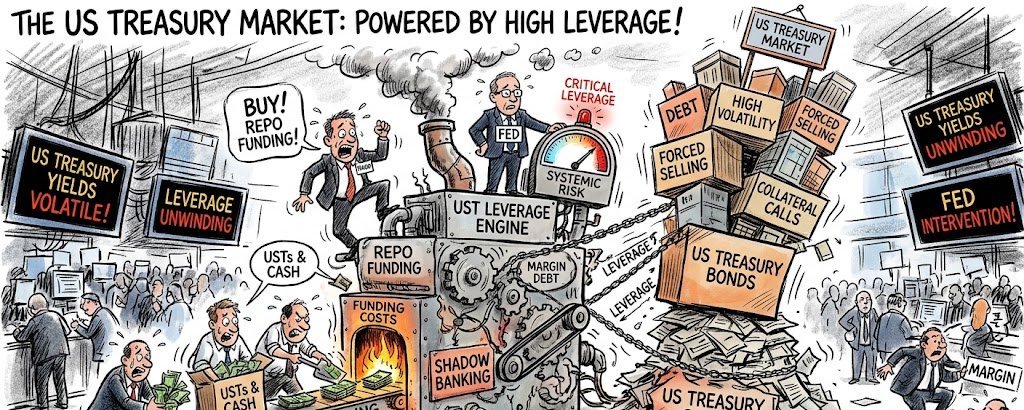
- A London-based hedge fund takes one dollar of real capital and buys a US Treasury bond
- It “pawns” that bond at the repo desk (repo = repurchase agreement, a short-term loan using the bond as collateral) and gets roughly 98 cents in cash back
- It uses those 98 cents to buy another Treasury, pawns that one too, and repeats the process, sometimes 20 to 50 times
- The resulting products are sold to European money market funds, often through swap agreements with major banks like Deutsche Bank
This mechanism allows one dollar of actual savings to support an entire stack of government bonds. It’s wonderfully capital-efficient for financing a $2 trillion annual deficit without needing $2 trillion in fresh savings. And it’s terrifyingly fragile.
Breaking the Buck: The 2008 Lesson We Forgot
If you’re wondering why this matters, consider what happens when this leveraged machinery seizes up. The industry calls it “breaking the buck”, when a money market fund can no longer maintain its $1.00 net asset value per share.
This almost happened in 2008. The Federal Reserve prevented a catastrophe by promising to print unlimited money over a weekend. That backstop worked because the situation was simpler then. Today’s complexity is on a different level entirely.
The concern among market analysts is that some US money market funds could trade below their nominal value for days or even weeks if Treasury markets seize up. The moment that happens, confidence in money market funds globally evaporates. And here’s the crux for European investors: when panic hits, investors don’t discriminate between US and euro funds. They run from all of them.

The German Counterargument: Is This Just Fear-Mongering?
Before you start liquidating your positions, let’s examine the counterarguments, because they’re actually quite strong.
First, most German investors hold money market funds in their functional currency. A euro-denominated fund like the DBX0AN doesn’t carry currency risk, which insulates it from dollar-specific chaos. As one commenter in the German investment community (r/Finanzen) pointed out, the majority of these funds are designed precisely to avoid currency fluctuations.
Second, and this is crucial, many European money market ETFs aren’t actually what they appear to be. The DBX0AN, for instance, isn’t technically a money market fund under European Securities and Markets Authority (ESMA) standards. It’s an ETF that uses a swap agreement with Deutsche Bank. Under this arrangement, Deutsche Bank essentially guarantees the fund’s returns in exchange for the returns on the underlying securities.
What does this mean for you? If the underlying Treasury market collapses, Deutsche Bank absorbs the losses, not you. Your risk isn’t tied to US government debt, it’s tied to Deutsche Bank’s survival. And as we’ve learned repeatedly since 2008, systemically important banks tend to get rescued.
The Contagion Question: What Happens When the Pawn Shop Closes?
But here’s where the debate gets genuinely interesting. What happens if the entire system seizes up simultaneously?
Let’s walk through the nightmare scenario:
Day 1: Repo rates spike (the cost of overnight borrowing against Treasuries explodes). Hedge funds face margin calls on their leveraged positions.
Day 2: Margin calls force bond sales. Those sales push yields higher. Higher yields trigger more margin calls. The spiral accelerates.
Day 3: Correlations go to one. Bonds, stocks, gold, crypto, everything drops together while the dollar spikes. This isn’t a diversified portfolio moment, it’s a “sell everything” moment.
Day 4: The Fed steps in with emergency measures. But European investors have already hit the “redeem” button on their money market funds.

At this point, even if your fund holds German bonds and has no direct US exposure, you’re facing a liquidity issue. When thousands of investors simultaneously demand their money back, the fund’s providers must sell whatever they can, whenever they can. That’s how contagion spreads, not through underlying asset quality, but through investor behavior.
The German Government’s Response: Why Bund Yields Matter
This isn’t just about your portfolio. The German government is feeling the pressure too. As noted in recent reporting, Finance Minister Lars Klingbeil (SPD) is already implementing spending cuts, including reductions in Wohngeld (housing allowance) and Elterngeld (parental allowance), partly due to rising debt servicing costs.
The Schuldenbremse (debt brake), enshrined in the German constitution, limits new federal borrowing and forces tough choices. But with infrastructure and defense spending demands growing, Germany faces its own fiscal pressure. The question isn’t whether Germany can afford its debt, Germany’s debt-to-GDP ratio sits at a manageable 63.5%, roughly half of America’s. The question is how much longer European governments can remain insulated from a US-driven global financial shock.
What Should You Actually Do?
Let me be direct: I’m not telling you to panic. The probability of a complete US debt crisis remains relatively low, and even in a crisis scenario, the institutional mechanisms for intervention are robust. But understanding the risk structure of your “safe” investments is essential.
First, know what you own. If you hold a synthetic ETF like the DBX0AN, your counterparty risk is with the German bank backing it (Deutsche Bank), not directly with US Treasuries. That’s actually reassuring, systemically important German banks have strong government backing.
Second, consider your time horizon. Money market funds are for money you might need within 12 months. If you don’t need the cash soon, the risks of holding cash in low-yield, unstable environments might outweigh the safety benefits. Long-term investors with diversified portfolios may be better positioned to weather volatility than those keeping everything in “safe” short-term vehicles.
Third, monitor one number: the SOFR-Fed Funds spread. This is the distance between the Secured Overnight Financing Rate (the rate at which banks lend Treasuries overnight) and the Federal Reserve’s benchmark rate. When that spread starts misbehaving, expanding rapidly, the system is sending you a warning. That’s your signal to reassess.
The Bottom Line
Your euro money market fund isn’t about to collapse tomorrow. The German financial system has demonstrated remarkable resilience through multiple global crises. But the infrastructure underpinning global money markets has fundamentally changed in the last decade. The marginal buyer of US Treasuries is no longer Japan’s pension system or China’s central bank, it’s a leveraged hedge fund operating through London.
That shift means the tail risk, however small, is now a plumbing event rather than an economic one. The question isn’t whether central banks will respond to a crisis, they unquestionably will. The question is what happens in the hours and days before that response arrives.
For most investors, the answer is: nothing catastrophic. You’ll see some volatility, maybe a brief dip in your fund’s value, and then stability returns as the authorities ride to the rescue. But “most” doesn’t mean “all.” And in a system where one participant’s leverage becomes another’s counterparty risk, complacency is the most dangerous position of all.
Understanding how your money works is the first step to protecting it. This isn’t cause for alarm, it’s cause for awareness.