
Picture this: You finally land that €75,000 salary in Munich. You mentally calculate, that’s €6,250 gross per month, maybe €4,300 net. Suddenly that two-bedroom in Schwabing and the weekend trips to the Alps feel within reach. Then the Bundeskabinett (Federal Cabinet) drops a bombshell that makes your Gehaltsabrechnung (payslip) look like it’s been through a shredder.
The German government just approved significantly higher social contribution ceilings for 2027, and here’s the kicker: this hits earners at just €75,000, not the €250,000 captains of industry. That’s roughly 30% of full-time employees who’ll feel this pinch, according to data from Destatis.

What Actually Changed in the Cabinet’s Decision
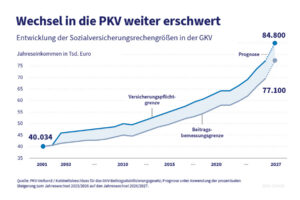
The Bundeskabinett approved the annual Social Insurance Calculation Regulation (Sozialversicherungsrechengrößen-Verordnung) on October 7, 2026. This isn’t a radical new tax, it’s the annual adjustment of the Beitragsbemessungsgrenzen (contribution assessment ceilings), the income thresholds up to which social contributions are deducted. But this year has a twist that’s making waves.
Here’s the damage:
Krankenversicherung (Health Insurance) Ceiling
- 2026: €5,812.50/month
- 2027: €6,375/month
- Increase: €562.50/month
Rentenversicherung (Pension Insurance) Ceiling
- 2026: €8,450/month
- 2027: €8,850/month
- Increase: €400/month
The government also pushed the Versicherungspflichtgrenze (insurance obligation threshold) from €6,450 to €7,012.50 per month, making it harder to switch from public to private health insurance.
The €102 Monthly Hit: Let’s Do the Math
For an employee earning above these thresholds with one child, the numbers break down to roughly €102 extra per month or €1,220 per year in additional social contributions. And here’s the part that stings even more: your employer matches that, so a position that cost €203 more per month just became more expensive for your company too.
But wait, there’s more bad news if you’re childless. The Pflegeneuordnungsgesetz (Care Reorganization Act) increases the childless surcharge for Pflegeversicherung (care insurance) from 0.6% to 0.9% starting in 2027. That pushes your total monthly hit to around €124.
Why Everyone’s Calling This “the €75,000 Trap”
This is where the frustration gets loud. The prevailing sentiment among employees is that we’re not talking about fat cats here, €75,000 is roughly €20,000 above the average German salary. It’s an engineer with 5 years of experience, a mid-level project manager, or a specialized IT professional. These are the people who studied for years, often with unpaid education periods, and are finally starting to see their career investment pay off.
Many employees make the sharp observation that someone earning €75,000 and someone earning €250,000 both pay roughly the same €102 extra per month. The system caps out, but the burden isn’t distributed proportionally. As one striking comment put it: Germany seems to be running a “Progressive-Fuck-You-Stichtagssicht” (progressive screw-you retrospective view) on your salary.
The deeper frustration stems from a broader pattern: Germany has some of the highest tax burdens on labor in the OECD, second only to Belgium. We don’t have a 401(k) equivalent, career advancement often gets blocked by a demographic bulge of Boomers staying in top positions, and housing costs in metropolitan areas continue to climb.
Beyond the Numbers: What This Signals
Here’s what makes this politically spicy: this isn’t the standard annual adjustment tied to wage growth. The government added an extra €300 above the regular wage-based increase specifically to close financing gaps in the health system. The plan, as reported by the Bundesregierung, is to stabilize contributions through 2027 by expanding the base rather than raising rates for everyone.
The Bundesrat (Federal Council) still needs to approve this, and the PNOG needs Bundestag approval, so technically nothing is set in stone. But political observers expect this to pass largely unchanged.
The “Lifestyle Teilzeit” Phenomenon
Perhaps the most interesting consequence is how this affects workforce behavior. There’s a growing movement toward what Germans call “Lifestyle Teilzeit” (lifestyle part-time work). The logic is simple: if your marginal tax rate on those extra hours approaches 60-70% (factoring in income tax plus social contributions), why bother? Some are literally considering reducing their hours to do social work instead, getting less money but more meaning.
Recent discussions around the German middle class income brackets have highlighted how someone with €75,000 gross and €2,000 net after rent and social contributions might actually having similar real purchasing power to someone earning €40,000 a decade ago. The question lawmakers face is whether these government tax relief measures actually reach the people who need them or just redistribute within the same middle-class bubble.
What This Means for Your Financial Planning
If you’re earning €75,000 or more (or planning to), here’s your reality check:
1. Your raise might not feel like a raise
With the 2027 thresholds, a €500 monthly raise could effectively become €350-400 net. This directly impacts the projected impact of future social security hikes on your net salary.
2. The regional divide gets wider
€75,000 in Chemnitz puts you in a different tax bracket than €75,000 in Munich, where the average Mietvertrag (rental contract) eats a third of your income. Ironically, Austria’s social security ceiling hikes show similar patterns, but their thresholds adjust proportionally to local cost of living.
3. Employer contributions become increasingly important
Remember, your employer pays roughly €102 more per month for you too. This is part of your total labor cost. In our analysis of employer-side contributions in Germany, we found that the complete package cost can be 30-40% higher than what you negotiate as gross salary.
Practical Steps to Protect Your Net Income
Given this reality, here’s what financial advisors are increasingly recommending:
Altersvorsorge (Retirement Savings)
Start a proper plan: A combination of ETF-Sparpläne (ETF savings plans) and perhaps a Riester-Rente (government-subsidized pension), despite its flaws, can help you claim back some tax advantages.
Gehaltsumwandlung (Salary Conversion)
Consider converting salary into employer-funded benefits like a Deutschlandticket (Germany ticket) or company pension contributions (bAV) can reduce your taxable base.
Steuererklärung (Tax Return)
Track meticulously: Many employees leave €300-1,000 on the table annually by not claiming deductions like Arbeitsmittel (work equipment), home office expenses, or professional development costs.
Overtime Considerations
Think deliberately about overtime: At this income level, overtime hours are taxed heavily. If your employer allows time off in lieu (Freizeitausgleich), that might be more valuable than the marginal net income.
The Bottom Line
The German social system is hitting an inflection point: it needs more revenue, but it’s targeting the “comfortable middle”, people who don’t feel rich but are being asked to fund the system. The cabinet’s decision to bundle the health, pension, and care insurance increases into one go creates a perfect storm for anyone crossing the €75,000 threshold.
This isn’t about being anti-solidarity. Most high earners accept that Germany’s social system provides genuine value. The frustration comes from feeling that the burden-sharing isn’t fair, that a €75,000 earner paying €124 more per month while a €250,000 earner pays the same sends the wrong signal about what Germans should aspire to.
As one engineer put it, “In Germany, it’s looking like it only makes sense to become a Beamter (civil servant) or receive Bürgergeld (citizen’s income). The center is getting squeezed.” That cynicism, whether you agree with it or not, is a real consequence of this policy.
The new limits take effect January 1, 2027, assuming Bundesrat approval. Now is the time to check your November-December payslips, calculate your 2027 baseline, and decide whether that next career step is worth it, or whether Freizeit is the new luxury.