
Then you run the numbers through a brutto-netto-rechner (gross-net calculator) for 2026. The result punches you in the gut: €3,995 lands in your account. Nearly 40% of your salary has vanished before you even see it. And that’s before you pay 19% Mehrwertsteuer (VAT) on everything you buy, or fund the GEZ (broadcasting fee) that haunts your evenings.
Welcome to Germany’s social security reality, where the 2026 contribution hikes mean your net pay just got recalculated into something that feels like a cruel joke.
The 2026 Numbers That Redraw Your Budget
Let’s cut through the bureaucratic fog and look at what actually happens to your €80,000 salary in 2026. Based on official Bundesfinanzministerium (Federal Ministry of Finance) programming data, here’s the breakdown for a single employee in Steuerklasse 1 (Tax Class 1), enrolled in gesetzliche Krankenversicherung (statutory health insurance) with a 2.9% Zusatzbeitrag (additional contribution), no children, and not paying Kirchensteuer (church tax):
| Deduction | Annual Amount | Percentage of Gross |
|---|---|---|
| Kranken-/Pflegeversicherung (Health/Care Insurance) | €7,777.13 | 9.72% |
| Rentenversicherung (Pension Insurance) | €7,439.99 | 9.30% |
| Arbeitslosenversicherung (Unemployment Insurance) | €1,039.99 | 1.30% |
| Lohnsteuer (Income Tax) | €15,694.00 | 19.62% |
| Total Employee Deductions | €31,951.11 | 39.94% |
Your €80,000 shrinks to €48,048.89 before you’ve bought a single Döner. But here’s the part that really stings: your payslip shows only half the story.
The Hidden Tax Your Employer Hopes You Never Notice
Flip open your Lohnabrechnung (pay statement). You’ll see each social insurance contribution listed twice, once as your share, once as the Arbeitgeberanteil (employer contribution). For that €7,439.99 you pay into Rentenversicherung (pension insurance), your employer pays another €7,439.99. Same for Krankenversicherung, Pflegeversicherung, and Arbeitslosenversicherung.
Many international residents assume this is a generous perk, like free office coffee. It’s not. That money comes from the same budget your salary is paid from. As one sharp commenter in German finance circles put it: whether your boss sends €1,000 as employer contribution plus €500 as employee contribution, or simply sends €1,000 from your pocket, the total cost to employ you, and the amount available for wages, is identical.
Add those hidden contributions to your visible deductions, and your true Abgabenlast (tax burden) climbs toward 50% of your total employment cost. The median earner in Germany, making around €44,000 annually, pays dangerously close to half their Arbeitgeberbrutto (employer gross) directly to the Fiskus (tax authorities). The system is designed so you never see this number, never feel the full weight of it. That’s not accidental.
The Midijob Mirage: Your Escape Hatch Just Got Smaller
For those earning between €603.01 and €2,000 per month, Germany offers the Übergangsbereich (transition zone), commonly called Midijob. The 2026 F-Faktor (factor) sits at 0.6619, meaning your Sozialversicherungsbeiträge (social insurance contributions) are calculated on a reduced basis.
Let’s say you earn €1,500 monthly in a Midijob. Instead of paying full contributions on €1,500, you pay on a reduced Bemessungsgrundlage (assessment basis) of €992.85. Your total employee contributions drop to about €402 (26.8% of gross) instead of the normal €630. You keep €1,097.90 net, significantly more than you would in a regular part-time position.
The catch? Earn €2,001 just once, and you’re booted from the zone entirely, paying full contributions retroactively. For students, parents returning from Elternzeit (parental leave), or retirees supplementing their Rente (pension), this creates a precarious ceiling. The 2026 adjustments keep the €2,000 upper limit but raise the lower threshold to €603.01, squeezing the window slightly tighter.
Beyond the Payslip: The Tax Avalanche That Follows
Your €48,048.89 net salary looks painful enough. But the extraction isn’t finished.
You spend €3,000 on groceries and consumer goods. The 19% Mehrwertsteuer (VAT) adds €570 in hidden taxes. You fill up your car with E10 petrol, 51% of that price is taxes and levies. Your electricity bill includes a 59% tax burden, with 25% going to Netzentgelte (grid fees) that flow to private corporations like TenneT (a Dutch state-owned operator, because privatizing the grid was clearly a brilliant idea that made everything cheaper, as the sarcastic commentators note).
Add the GEZ, the KFZ-Steuer (vehicle tax), the Grunderwerbssteuer (property transfer tax) if you dare buy property, and the Erbschaftssteuer (inheritance tax) when you inherit it. Every financial transaction becomes a revenue stream for the state.
One frustrated resident captured the sentiment perfectly: after watching his net pay get taxed at every turn, he turned on the news to hear a politician declare, “Starke Schultern müssen mehr tragen, die Menschen sind zu Opfern bereit” (Strong shoulders must carry more, people are willing to make sacrifices). At that moment, he reported, “Du verlierst den Verstand” (you lose your mind).
Why the 2026 Adjustments Hit Differently
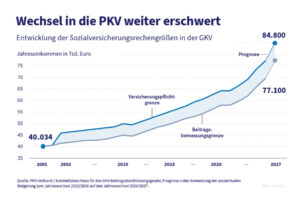
The 2026 changes aren’t dramatic headline-grabbers. Contribution rates remain stable at 30.65% total (employee + employer). The Beitragsbemessungsgrenzen (contribution assessment ceilings) have risen modestly. But three factors make this year’s forecast particularly spicy:
First, inflation has already eroded purchasing power by roughly 15-20% since 2020. That €80,000 salary feels more like €65,000 did three years ago, but the tax brackets and contribution thresholds haven’t kept pace. You’re paying 2026 taxes on 2020 purchasing power.
Second, the Solidaritätszuschlag (solidarity surcharge) exemption threshold remains at €20,350 annual income, capturing more middle-income earners as wages rise nominally. Many who never paid it before are now contributing 5.5% on top of their income tax.
Third, the debate around Ehegattensplitting reforms and top tax rate thresholds is creating uncertainty. The 42% top tax rate kicks in at €66,760 in 2026, hardly “top earner” territory in cities like Munich or Frankfurt. Combined with social security contributions, your marginal rate on additional income can exceed 55%.
The Expat Calculation: Germany vs. The Alternative
For international talent, this math becomes a decision point. Compare your €80,000 German salary to a CHF 115,000 offer in Basel. The Swiss number looks 43% higher, but the net purchasing power gap is even wider after accounting for Switzerland’s lower tax burden and social contributions. Our analysis of cross-border tax burdens shows that choosing Germany based on gross salary alone could cost you €300,000 over a decade.
Even within the EU, the comparison is stark. An Austrian tech salary that looked competitive in 2020 has lost 25% of its purchasing power to inflation and tax creep by 2026. The math your employer hopes you won’t do reveals that nominal salary increases often mask real-term pay cuts.
What You Can Actually Do
The Bottom Line
Germany’s social security system delivers world-class Krankenversicherung (health insurance), solid Rentenversicherung (pension coverage), and robust Arbeitslosenversicherung (unemployment protection). But the 2026 contribution structure means a median earner parts with nearly half their total employment cost before making a single purchase.
The system operates with the same efficiency as a Deutsche Bahn train, usually impeccable, until construction on the line forces you onto a replacement bus service that costs twice as much and takes three times longer. The difference? With Deutsche Bahn, you see the delay coming. With German social security contributions, the real impact is hidden in footnotes on your Lohnabrechnung.
Your €80,000 salary isn’t really €80,000. It’s €48,000 of net pay, minus another €8,000-€10,000 in consumption and hidden taxes, leaving you with perhaps €38,000 of actual purchasing power. That’s not a tax system. That’s a magic trick where your money disappears in plain sight.
Run the numbers. Know your real rate. And next time a politician talks about “fair contributions”, you’ll know exactly what that means for your bank account.
Calculate your exact 2026 net salary using official Bundesfinanzministerium data: The interactive spreadsheet with complete calculations for incomes from €24,000 to €500,000 is available here.