You’re Not a Spitzenverdiener: The Class Warfare Hidden in Germany’s New Salary Brackets
What used to be a vague cultural concept or a heated dinner party debate is now, according to leaks, codified in a table floating around the Finanzministerium (Federal Ministry of Finance). It’s a hierarchy of worth, German bureaucratic style. And it’s not some abstract debate, it’s the foundation for everything from your Pflegeversicherung (Long-Term Care Insurance) premiums to the next major tax reform. So where do you really stand?
The Leaked Ladder: From Geringverdiener to Topverdiener
Let’s cut through the noise. The supposed official table, which a recent public information request is seeking to confirm, reportedly looks something like this (monthly gross income):
- Geringverdiener (Low Earner): Ab (from) €1,195
- Niedrigverdiener (Low Earner): Ab €1,792
- Mittelverdiener (Middle Earner): Ab €2,378
- Normalverdiener (Normal Earner): Ab €3,314
- Besserverdiener (Better Earner): Ab €4,071
- Gutverdiener (Good Earner): Ab €5,859
- Spitzenverdiener (Top Earner): Ab €8,359
- Topverdiener (Top Earner): Ab €23,277
Immediately, the eyebrows go up. A full-time Mindestlohn (Minimum Wage) employee, earning about €2,409 gross per month, is already a middle earner according to this scale. The semantic jump from “better” to “good” is a mere €1,788, while the chasm from “top” to the ultimate “top” is a dizzying €14,918. The optics are, charitably, interesting.
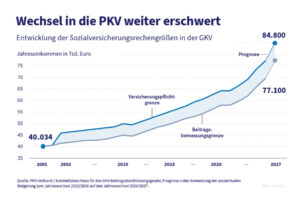
But this isn’t just a philosophical exercise. This classification has sharp, financial teeth. For instance, the government’s planned Gesundheitsreform (Health Reform) explicitly targets Gutverdiener by raising the Beitragsbemessungsgrenze (contribution assessment ceiling) and making it harder to switch to Private Krankenversicherung (Private Health Insurance), according to reports discussed by Bayerischer Rundfunk.

The Devil is in the (Statistical) Detail
The instant pushback from the online discourse isn’t about the numbers themselves, but about what they represent. A key point of contention? These figures are based on all income earners, including part-time workers. The median income for full-time employees in 2025 was reportedly around €54,066 annually, or €4,505 per month, which would place someone solidly in the “Normalverdiener” category.
This means the official “Mittelverdiener” bracket starts significantly lower than the median full-time wage, a detail that makes the “Besserverdiener” label feel like low-hanging fruit. As one observer noted, telling someone earning under €50k that they’re a “better earner” is a masterclass in motivational linguistics.
The political implications are massive. This table gives the government a neat, official-looking tool to justify policy. Want to raise contributions for the Pflegeversicherung? Target anyone above €5,859 (Gutverdiener). Need to fund a tax cut? Hike rates for those above €8,359 (Spitzenverdiener). It’s a sliding scale of social contribution, now with official labels.
The Real Battle: Spitzensteuer vs. Solidaritätszuschlag
This is where the rubber meets the Autobahn. The current coalition’s internal battle revolves squarely around these definitions. The SPD’s finance minister, Lars Klingbeil, wants a major Einkommensteuerreform (Income Tax Reform) by 2027, aiming to permanently relieve small and middle incomes. His math? It has to be haushaltsschonend (budget-friendly). Translation: the money must come from somewhere else.
That “somewhere else” is the pockets of those at the top of this new ladder. As reported analyses note, the plan is for “Spitzenverdiener with six-figure salaries” to foot the bill for relief for the 95% below them. The Spitzensteuersatz (Top Tax Rate) of 42% kicks in at just under €70,000 per year, a threshold many skilled professionals hit mid-career.
Chancellor Friedrich Merz (CDU) and even CSU leader Markus Söder have shown a surprising openness to raising the “Reichensteuer” (Wealth Tax, the 45% rate) on incomes above €280,000, but they draw the line at increasing the Spitzensteuersatz itself. In their view, the real middle-class squeeze isn’t solved by taxing the upper-middle-class professional more. They want spending cuts instead. This is the core of the coalition’s public rift.
For you, the person trying to plan a life here, this is the difference between a real tax cut and a reshuffling of the deck chairs. It’s the difference between genuine relief and getting caught in what many expats call the Spitzensteuer trap for Germany’s middle-class ‘rich’.
So, Are You “Rich” in Germany? Let’s Talk Netto.
Gross is one thing. Net is another. The really eye-opening comparison comes from looking at Nettoeinkommen (Net Income). According to research from the Institut der Deutschen Wirtschaft (IW), you’re considered “reich” (rich) in Germany if your monthly net household income is more than 250% of the median.
For a single person, that magic number is around €5,780 net per month. Let that sink in. After Lohnsteuer (wage tax), Sozialabgaben (social security contributions), and the Solidaritätszuschlag (solidarity surcharge), a single Gutverdiener (€5,859 gross) is likely taking home less than what the IW defines as the threshold for “rich.”
This exposes the central tension. You can be officially classified as a “good earner” by the state, burdened with higher contributions, while your actual disposable income feels anything but wealthy, especially in cities like Munich or Hamburg. It’s why discussions about what Germans actually mean when they talk about a ‘good salary’ are so fraught.
The Takeaway: Labels Have Bills Attached
Don’t get lost in the semantics. The core lesson is practical: in Germany, your official income classification is a direct lever for your cost of living. Being deemed a Gutverdiener or Spitzenverdiener isn’t an accolade, it’s a precursor to higher levies.
- Your Tax Return is Your Defense: Understand your Steuererklärung (Tax Return). Deductions for Werbungskosten (work-related expenses), home office, and Vorsorgeaufwendungen (provision expenses) become critical to managing your net income.
- Watch the Reform Debate: The fight over the Spitzensteuersatz threshold is a fight over your wallet. Will it stay near €70,000 or jump to €80,000? The difference is thousands of euros.
- Think in Net, Not Gross: Always calculate your Netto (net salary) using a reliable calculator. A €75,000 offer might look great until you see the €3,800 monthly take-home.
- Plan for the Squeeze: If you’re hovering around the Gutverdiener mark, start planning for the increased Krankenkasse (Health Fund) and Pflegeversicherung contributions. This isn’t abstract policy, it’s your next pay slip.
The new official brackets aren’t just a curiosity. They are a political weapon, a budgetary tool, and a stark reminder that in Germany, your income is never just a number. It’s a class, a category, and an open invitation for the state to re-evaluate its share. Knowing where you stand is the first step to understanding exactly what that will cost you. And for many, it highlights the middle-class trap regarding retirement savings, where even “good” earnings feel precarious against future costs.