
It’s 11 PM on July 30th, you’re 48 hours away from your Steuererklärung (tax return) deadline, and you’ve just realized that your “simple” crypto trading hobby has metastasized into a 500-transaction nightmare spanning three exchanges and a hardware wallet. The Finanzamt (Tax Office) wants its cut, but first, you need to figure out what you actually owe. Sound familiar?
Welcome to the beautiful mess of German crypto taxation, where the rules are made up and the points (or in this case, the coins) don’t matter, until they suddenly do, and you’re facing a Nachzahlung (back payment) with interest. The good news? Some trading platforms are finally waking up to our collective suffering. The bad news? Their solutions work about as reliably as a Deutsche Bahn timetable during leaf-fall season.
FIFO: The Method Germany Grudgingly Accepts (But Doesn’t Legally Require)
Here’s the first dirty little secret: Germany has no explicit law stating you must use FIFO (First In, First Out). None. The BMF-Schreiben (Federal Ministry of Finance letter) that everyone references? It’s guidance, not gospel. In theory, you could argue for LIFO, HIFO, or even the “I closed my eyes and pointed” method.
In practice? Try explaining LIFO to your local Finanzamt clerk during a Betriebsprüfung (tax audit) and watch their expression shift from confusion to suspicion to “we’re definitely auditing everything now.” FIFO is the standard because it’s what the Finanzverwaltung (tax administration) understands, accepts, and expects. It’s the path of least resistance through a bureaucracy that values Nachvollziehbarkeit (traceability) above all else.
The research confirms this: while not legally mandated, FIFO is the “sicherste und empfohlene Methode” (safest and recommended method). It’s the difference between a smooth Steuererklärung and a three-year correspondence marathon with your Finanzamt.
Trade Republic’s CSV Export: A Glimmer of Hope (With Glitches)
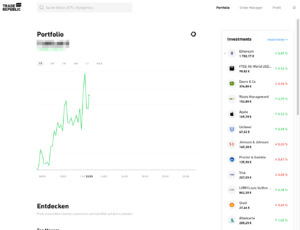
Trade Republic recently rolled out a feature that lets you download your complete transaction history as a CSV file, with FIFO calculations baked right in. For every position, you can see each purchase matched with its current value and theoretical gain, exactly what you need to estimate your Steuerschuld (tax liability) before you hit sell.

This should be revolutionary. Finally, a German broker that understands we don’t all want to pay 200€ annually for specialized crypto tax software. You download the file, pop it into Excel or Google Sheets, and boom, instant clarity on what that Bitcoin sale will cost you in Steuern (taxes).
Except, as one user discovered, sometimes you get an empty CSV file. Just headers, zero data. The support ticket writes itself: “Ihre FIFO-Funktion funktioniert super… nicht.” (Your FIFO function works great… not.) Another trader found their buy-in prices for a 2023 overnight rate swap were completely wrong, showing inflated numbers that would have cost them thousands in overpaid taxes if they’d trusted the export blindly.
The Step-by-Step Reality Check
So how do you actually use these CSV exports without landing in Steuerhinterziehung (tax evasion) territory? Here’s the unvarnished process:
Step 1: Export everything, immediately
Don’t wait until December. Export your data monthly, because some platforms only keep 90 days of history accessible via API, and CSV exports can mysteriously fail when you need them most. Store these files like they’re your Anmeldung (registration) documents, because they basically are.
Step 2: Verify every single line
That CSV file is a starting point, not gospel. Cross-reference three random transactions against your original Abrechnungen (trade confirmations). Check dates, times, quantities, and especially the Kaufpreis (purchase price). If those three are correct, you have reasonable confidence. If not, you’ve just saved yourself from a world of pain.
Step 3: Understand what FIFO actually means for you
Let’s say you bought 0.5 BTC in January 2023 for 15,000€, another 0.5 in June 2023 for 20,000€, and you sell 0.6 BTC in February 2024 for 33,000€. Under FIFO:
– The first 0.5 BTC sold comes from your January purchase (15,000€ cost basis)
– The remaining 0.1 BTC comes from your June purchase (4,000€ cost basis)
– Your total gain: 33,000€ – 19,000€ = 14,000€
But here’s the kicker: if that January purchase was over a year old when you sold, that portion is steuerfrei (tax-free) under the 1-Jahres-Regel (1-year rule). Your CSV export should flag this, but you need to understand the logic to catch errors.
Step 4: Calculate the 1-Jahres-Regel manually
The CSV might show gains, but it won’t always correctly apply the Haltefrist (holding period). You need to add a column calculating days held, then filter for sales where the oldest coins were held <365 days. This is where most traders mess up, they see a gain and assume it’s taxable, not realizing half their position is already steuerfrei.
When CSV Exports Become a Dead End
Here’s where the free solution collapses: multiple Börsen (exchanges). Your Trade Republic CSV is perfect, until you remember you also traded on Binance, Coinbase, and that sketchy DEX you used for one token that mooned. The FIFO calculation only works within a single platform. The Finanzamt doesn’t care where your coins lived, they want a consolidated view.

This is where tools like Parqet, Waltio, or Blockpit become unavoidable. One user mentioned importing Trade Republic data into Parqet, then using its MCP integration to build custom analyses. Another detailed how Waltio connects to Bitget via API, automatically pulling transactions and applying FIFO across all connected accounts. The cost? Typically 100-200€ per year, which suddenly seems cheap when you’re facing 20 hours of manual spreadsheet work.
The research shows these tools aren’t luxuries, they’re necessities once you cross about 100 transactions or use more than two platforms. They handle the multi-exchange FIFO nightmare, track transfers between your own wallets (which aren’t taxable but must be documented), and generate Finanzamt-ready reports.
The DAC8 Tsunami Coming in 2026
If you’re thinking “I’ll just wing it and hope the Finanzamt doesn’t notice”, I’ve got bad news. The DAC8 regulations kick in January 1, 2026, requiring all crypto platforms to automatically report your complete transaction history to German authorities. Every. Single. Trade.
The fantasy of “Auslandsbörsen sind anonym” (foreign exchanges are anonymous) dies with DAC8. Binance, Coinbase, Kraken, they’re all handing over data. Your Steuererklärung must match what the Finanzamt receives automatically, or you’re inviting a Betriebsprüfung.
This makes proper FIFO documentation non-negotiable. You can’t plead ignorance when the Finanzamt has a complete data feed showing you sold 2.3 ETH on March 15th. You need to prove your cost basis, holding period, and that you applied FIFO consistently.
The Individual Assignment Loophole (That Almost Nobody Uses)
Here’s a spicy detail most guides bury: Einzelzuordnung (individual assignment) is technically possible. If you keep your coins in separate wallets with crystal-clear documentation, you can sell specific lots. Wallet A contains your 2022 purchases (steuerfrei), Wallet B your 2024 purchases (taxable). Sell from Wallet A, pay zero Steuern.
The Catch: But, and this is a huge aber, the Voraussetzungen (requirements) are brutal: “klare Trennung von Wallets oder Accounts, vollständige Transaktionshistorie, eindeutige Dokumentation.” One mistake, one transfer you can’t explain, and the Finanzamt rejects your whole approach.
For 99% of traders, this is a theoretical option, not a practical one.
So What’s the Actual Playbook?
- Start with free CSV exports from every platform you use. Store them religiously.
- Build a master spreadsheet that combines all data, applying FIFO manually for the first 50-100 transactions. This teaches you the logic.
- When complexity hits (multiple exchanges, staking, DeFi), bite the bullet on software. The 150€ you spend beats a 5,000€ Nachzahlung plus Strafen (penalties).
- Never trust the platform’s FIFO calculation blindly. Always spot-check. One user found their DBX0AN swap prices were completely wrong, imagine discovering that during an audit.
- Document everything. That 0.01 ETH transfer between wallets? Document it. The gas fees? Track them, they’re absetzbar (deductible).
- Consider the Austrian angle if you have cross-border tax situations. While Germany has its quirks, Austrian rules have their own traps, like the E1kv form for loss offsets and unique ETF taxation that could affect your strategy if you’re diversified across markets. Offsetting realized losses and claiming refunds via E1kv form and Navigating Austrian ETF cost basis nuances might save you from parallel tax nightmares.