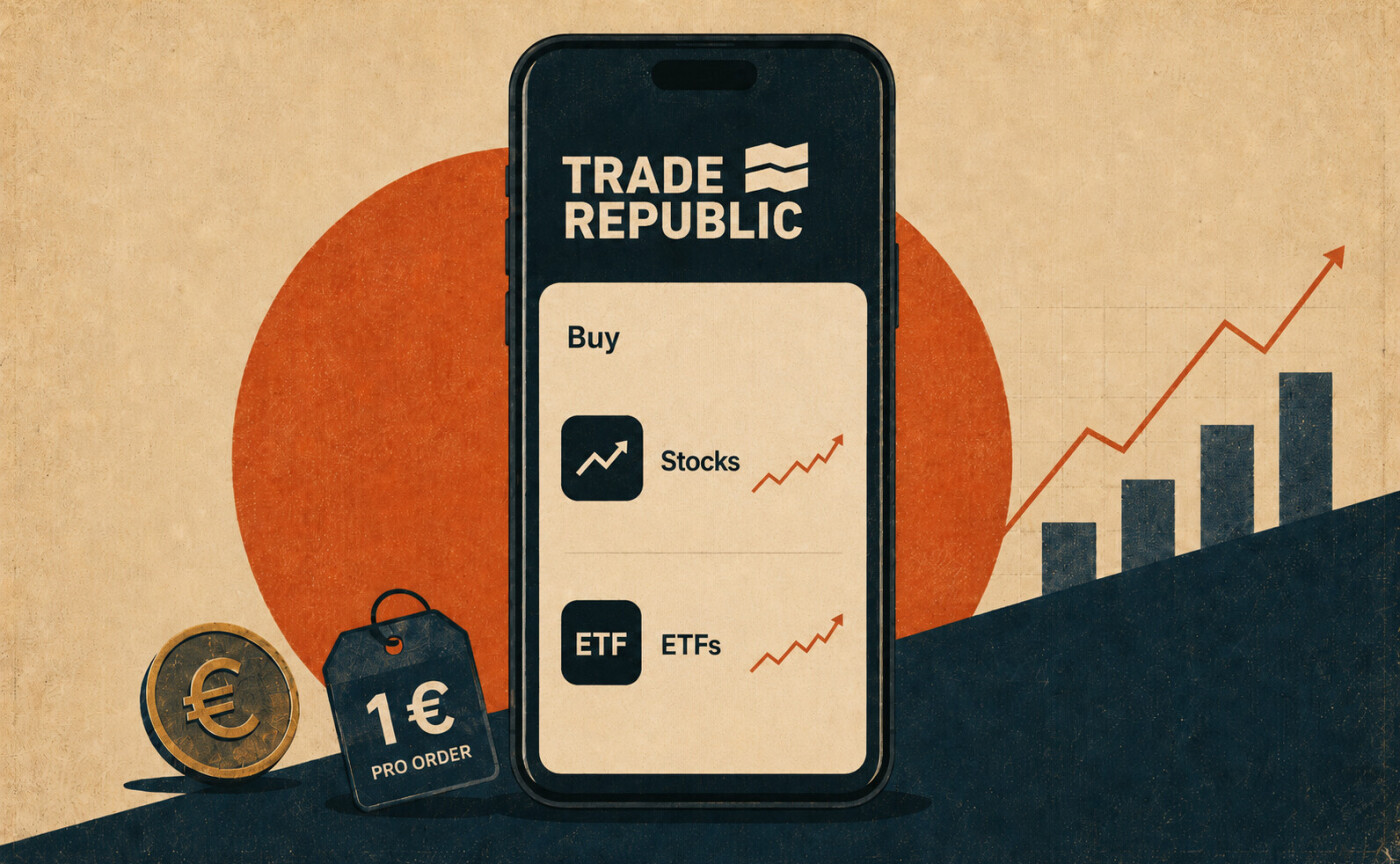
You open your Trade Republic app on a lazy Thursday afternoon, ready to snag a few shares of that semiconductor stock you’ve been eyeing. You tap “buy”, and there it is: a new option to pay €2 instead of the usual €1. For a split second, you feel like you’re being offered a VIP upgrade on a budget airline. But this isn’t premium legroom, it’s the sound of the European neobroker party winding down.
Trade Republic just dropped a bombshell on July 2, 2026. The €1 order isn’t going anywhere, but there’s now a €2 “Direct Price” order sitting right next to it. And the reason? The EU’s ban on Payment for Order Flow (PFOF) kicked in on July 1, 2026, pulling the rug out from under the business model that made cheap trading possible in the first place.
Let’s cut through the marketing speak and figure out what this actually means for your portfolio.
The €1 Order Isn’t Dead, But It’s Different
Here’s the headline Trade Republic wants you to hear: the €1 order stays. And technically, that’s true. But the €1 order you knew has been quietly replaced.
The old model was simple: you paid €1, and your order went to Lang & Schwarz Exchange (LS Exchange), a single trading venue. Trade Republic got a kickback from the market maker for routing your order there. That’s PFOF, and it’s now illegal across the EU as of July 1, 2026.
The new €1 “Bestpreis-Order” (Best Price Order) works differently. An algorithm now scans 30 global exchanges, Xetra, Euronext, NYSE, Nasdaq, and others, and executes your trade at the best available price. Trade Republic acts as the counterparty, meaning they’re now the market maker themselves. The €1 fee stays, but the mechanics have fundamentally shifted.
The €2 Elephant in the Room
Here’s where it gets spicy. Alongside the revamped €1 order, Trade Republic introduced a €2 “Direktpreis-Order” (Direct Price Order). This is the option you choose when you want to pick your own exchange, Xetra, NYSE, Nasdaq, you name it. You get to use limit orders, stop orders, and see the full order book. But it costs double.
The reaction from the community has been predictable. Many international residents report feeling like they’re being nickel-and-dimed, with one observer calling it “a trick to move away from the €1.” And honestly? There’s some truth to that.
But here’s the thing: compared to traditional brokers, €2 for a direct Xetra or Nasdaq trade is still cheap. At Flatex, a Xetra order for €1,000 costs around €8. At DADAT Bank, you’re looking at over €10 including third-party fees. So the €2 option isn’t expensive, it’s just more expensive than what you’re used to.
The PFOF Ban: What Actually Happened
Let’s rewind. On July 1, 2026, the EU’s ban on Payment for Order Flow took full effect across all member states, including Austria. For years, neobrokers like Trade Republic routed customer orders to specific market makers (like Lang & Schwarz) and received kickbacks for doing so. This is what made €1 trades and free ETF savings plans possible.
The EU decided this created a conflict of interest, brokers might send orders to the highest bidder rather than the best execution venue. Multiple studies, including one from the German financial regulator BaFin, couldn’t find clear evidence of customer disadvantage. The ban came anyway.
For Trade Republic, PFOF had already shrunk to less than 20% of revenue, according to co-founder Christian Hecker. But it still required a fundamental restructuring of their trading infrastructure.
The New Two-Tier System: What You Actually Get
Here’s the breakdown that matters for your wallet:
The €1 Bestpreis-Order (Best Price Order): An algorithm scans 30 exchanges in real-time and executes at the best available price. You get market orders only. Trade Republic acts as the counterparty. This is the default option, and for most buy-and-hold investors, it’s probably fine.
The €2 Direktpreis-Order (Direct Price Order): You pick the exchange, Xetra, NYSE, Nasdaq, Euronext, you name it. You can use limit orders, stop orders, and see the full order book. This is for active traders who want control.
The key difference? With the €1 order, you’re trusting Trade Republic’s algorithm to get you the best price. With the €2 order, you’re paying for the privilege of making that decision yourself.
What This Means for Austrian Investors
For those of us in Austria, there’s an additional layer to consider. Trade Republic is now steuereinfach (tax-simple) for Austrian residents, meaning they handle the Kapitalertragsteuer (KESt) (capital gains tax) automatically. This is a huge advantage over brokers like Interactive Brokers or Degiro, where you’re stuck doing your own tax reporting to the Finanzamt (Tax Office).
But the new fee structure introduces a question: if you’re using the €2 Direct Price order to trade on Xetra or the Vienna Stock Exchange (Wiener Börse), are you still getting the same tax-simple treatment? The answer appears to be yes, but it’s worth confirming with Trade Republic’s support before you start routing orders manually.
The Bigger Picture: Is This the End of Free Trading?
Let’s be honest: the “free trading” era was always a bit of a mirage. You weren’t paying an explicit fee, but you were paying through potentially wider spreads and the knowledge that your order was being routed to whoever paid the most for it. The PFOF ban eliminates that hidden cost structure, but it also eliminates the subsidy that made €1 trading possible.
The question isn’t whether trading will get more expensive, it’s whether the increased transparency and better execution quality will offset the higher explicit fees.
For the average Austrian investor who buys a few ETFs each month via Sparplan (savings plan), nothing changes. Those remain free. For the occasional stock picker using the €1 Bestpreis-Order, the cost stays the same. It’s only the active traders who want specific exchange routing who’ll feel the €2 pinch.
The Real Story: Trade Republic Is Becoming a Market Maker
Here’s the part that doesn’t get enough attention. Trade Republic is now executing orders “against their own book.” They’re the counterparty to your trade. This means they profit from the spread, the difference between the buy and sell price, rather than from a kickback from an external market maker.
Critics argue this creates the same conflict of interest that PFOF was supposed to eliminate. The broker now profits from how your order is executed, just through a different mechanism. Trade Republic provides transparency tools, an aggregated order book, execution reports, but the data comes from their own systems.
As one industry observer noted, “The conflict of interest hasn’t disappeared. It’s just been moved into a form that doesn’t trigger disclosure requirements.”
The Web Terminal: Trade Republic’s Real Play
The €2 fee is getting all the headlines, but the real story might be the new Web Terminal. Trade Republic is launching a free browser-based trading platform with professional charting, stock and derivatives screeners, portfolio analysis, and live market data. Co-founder Christian Hecker called it “a kind of Bloomberg terminal for retail investors.”
This is Trade Republic’s attempt to poach active traders from Interactive Brokers, Flatex, and DADAT. These are the high-volume customers who generate real revenue. The €2 fee is a small price to pay if it means capturing a slice of that market.
The Austrian Angle: Steuereinfach (Tax-Simple) Still Matters
For Austrian residents, the key question is whether the new fee structure affects Trade Republic’s tax-simple status. The good news: it doesn’t. Trade Republic remains steuereinfach (tax-simple) for Austrian customers, meaning they handle the Kapitalertragsteuer (KESt) (capital gains tax) automatically. This is a massive advantage over brokers like Degiro or Interactive Brokers, where you’re responsible for your own tax reporting to the Finanzamt (Tax Office).
But here’s a practical tip: if you’re using the €2 Direct Price order to trade on the Vienna Stock Exchange (Wiener Börse) or Xetra, double-check that the tax reporting still works seamlessly. In theory, it should. In practice, Austrian tax law has a way of surprising you.
The Competitive Landscape: Who Benefits?
The PFOF ban isn’t just affecting Trade Republic. Scalable Capital launched its own exchange (EIX) in partnership with the Börse Hannover back in December 2024. N26 is reintroducing order fees at €0.90 per trade starting September 2026. DADAT Bank has optimized its fee model for Gettex and Baader Bank.
The traditional banks are also making moves. The S Broker (Sparkassen-Finanzgruppe) slashed its fees to €0.95 per order and eliminated savings plan fees entirely. Comdirect is offering reduced prices for new customers. The competitive landscape is shifting rapidly.
For Austrian investors, the key question remains: which broker offers the best combination of low fees, good execution, and tax simplicity? Trade Republic’s new structure is competitive, but it’s no longer the obvious winner it once was.
The Bottom Line: Should You Care?
If you’re a typical Austrian investor with a monthly ETF-Sparplan (ETF savings plan) and the occasional stock purchase, the €2 fee is irrelevant. You’ll use the €1 Bestpreis-Order and never think about it.
If you’re an active trader who wants to route orders to specific exchanges, the €2 fee is still cheap compared to traditional brokers. A Xetra order at Flatex costs around €8 for a €1,000 trade. At DADAT, it’s over €10. Trade Republic’s €2 is a bargain.
The real question is whether you trust Trade Republic’s algorithm to get you the best price. The company provides transparency tools, an aggregated order book, execution reports, but the data comes from their own systems. For most investors, the €1 Bestpreis-Order will be perfectly adequate. But if you’re trading large volumes or illiquid stocks, the €2 Direct Price order might actually save you money through better execution.
The Bottom Line for Austrian Investors
Trade Republic’s new fee structure isn’t the end of free trading. It’s the end of the illusion that trading was ever truly free. The costs were always there, they were just hidden in spreads and kickbacks. Now they’re explicit, transparent, and slightly higher for those who want control.
For the typical Austrian investor with a monthly ETF-Sparplan (ETF savings plan) and the occasional stock purchase, nothing changes. For active traders, the €2 fee is still competitive. And for everyone, the increased transparency is a net positive.
The question isn’t whether Trade Republic is still cheap. It is. The question is whether you trust their algorithm to get you the best price, or whether you’re willing to pay €2 for the peace of mind that comes with choosing your own exchange.
What’s Next? The Competitive Landscape Shifts
The PFOF ban isn’t just affecting Trade Republic. Scalable Capital launched its own exchange (EIX) in partnership with the Börse Hannover. N26 is reintroducing order fees at €0.90 per trade starting September 2026. DADAT Bank has optimized its fee model for Gettex and Baader Bank.
The traditional banks are also making moves. The S Broker (Sparkassen-Finanzgruppe) slashed its fees to €0.95 per order and eliminated savings plan fees. Comdirect is offering reduced prices for new customers. The competitive landscape is shifting rapidly.
For Austrian investors, the key is to compare total costs, order fees, spreads, and tax handling. Trade Republic remains steuereinfach (tax-simple) for Austrian residents, which is a significant advantage. But the new fee structure means you should think carefully about which order type you use and when.
What’s Next? The Consolidation Wave
The PFOF ban is likely to trigger a consolidation wave among European neobrokers. Not all of them have the scale to build their own trading infrastructure or absorb the lost revenue. We’re likely to see mergers, acquisitions, and some brokers simply shutting down.
For Austrian investors, this means one thing: don’t put all your eggs in one basket. If you’re using Trade Republic for your main portfolio, consider keeping a backup account at a traditional broker like Flatex or DADAT. If Trade Republic’s systems go down during a market crash, and they have a history of exactly that, you’ll want an alternative.
The €2 fee isn’t the end of the world. But it’s a reminder that in the world of Austrian finance, nothing stays free forever. The question is whether the increased transparency and better execution quality are worth the extra euro. For most of us, the answer is probably yes. But it’s worth keeping an eye on the competition, because the neobroker wars are far from over.