
You glance at your payslip, that monthly punch to the gut. Between income tax and social security, a third of your salary has vanished before it even hits your account. But here’s what really stings: a chunk of that money isn’t funding your healthcare, it’s paying off someone else’s debt.
Welcome to Germany’s statutory health insurance (Gesetzliche Krankenversicherung or GKV) cross-subsidy system, where employed citizens quietly shoulder a €13.5 billion mountain of unpaid contributions, primarily racked up by self-employed workers and Bürgergeld (citizen’s benefit) recipients. And nobody asked if you were okay with that.
The Hidden Tax on Your Paycheck
Let’s be blunt. When you see that Krankenkassenbeitrag (health insurance contribution) line item, you assume it’s buying you healthcare coverage. That’s the deal, right? You pay in, you get medical treatment when needed. Simple.
Except it’s not. The GKV-Spitzenverband (National Association of Statutory Health Insurance Funds) has been sounding alarms about contribution debts that have ballooned to €13.5 billion by the end of 2024. These aren’t just recent defaults, these are accumulated shortfalls from people who couldn’t or wouldn’t pay their share.
The kicker? The system spreads these losses across all members. Your contributions don’t just fund your doctor visits, they fill the gaps left by others. It’s a financial solidarity principle that sounds noble in theory but feels like a sucker punch when you’re the reliable payer subsidizing those who aren’t.
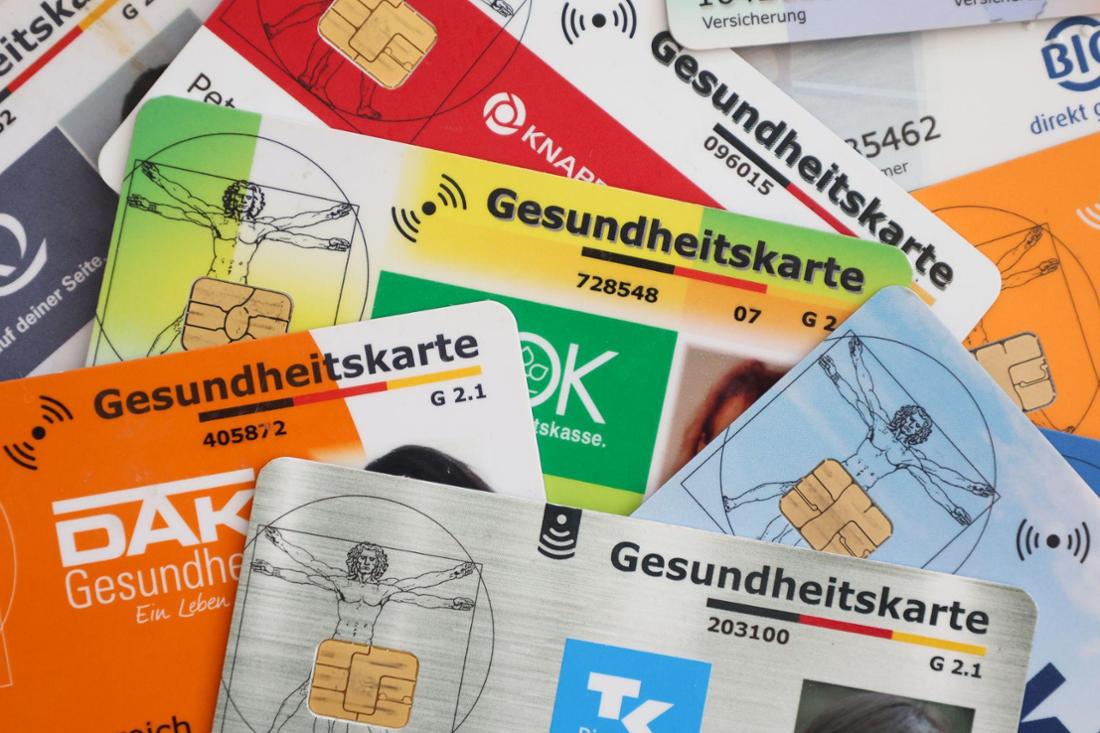
Your health insurance card, funding more than just your medical care.
Why the Self-Employed Become Debtors
If you’re self-employed in Germany, the GKV treats you like a second-class citizen from day one. While employees enjoy automatic contributions based on actual salary, with employers footing half the bill, self-employed workers face a Kafkaesque calculation nightmare.
The system demands they pay based on their last Einkommensteuerbescheid (income tax assessment), which might reflect earnings from two years ago. Just started your business and making peanuts? Tough luck. The minimum assessment base is €1,318.33 per month in 2026, even if your actual income is zero. That translates to a minimum health insurance contribution of around €236 monthly, regardless of whether you’ve earned a cent.
The result? Many self-employed individuals, especially in volatile industries like freelance design or gig economy work, simply can’t keep up. They fall behind, accumulate debts, and eventually the Krankenkasse (health insurance fund) writes off the losses. Those write-offs become everyone else’s problem.
According to the Bundesgesundheitsministerium (Federal Ministry of Health), these debts stem from “financial instability at voluntarily insured self-employed persons” and “payment incapacity in case of extensive income and asset poverty.” Translation: people who genuinely can’t pay, and the system isn’t designed to handle that reality.
The Bürgergeld Gap: When the State Doesn’t Pay Its Share
Here’s where it gets politically spicy. Bürgergeld recipients, people receiving Germany’s new citizen’s benefit, are technically covered by the GKV. But the state doesn’t fully reimburse the Krankenkassen for their costs. The federal government covers some expenses, but not enough to make the Krankenkassen whole.
This creates a two-tier subsidy system: employed people subsidize both the self-employed who can’t pay, and welfare recipients whose costs aren’t fully covered by the state. It’s a stealth tax increase disguised as solidarity.
The Frankfurter Rundschau reports that CDU and SPD are already fighting over how to handle this specific issue, with different visions for Krankenkassenreform (health insurance reform). But while politicians debate, your contribution keeps rising.
The Brutal Math: What You Actually Pay
Let’s talk numbers, because they tell a story that political rhetoric can’t hide.
In 2026, a self-employed person with children pays up to €1,226.44 monthly for GKV coverage. An employee? Their maximum share is €613.22. That’s right, self-employed workers pay double, with no employer to split the cost.
Even worse, that self-employed person earning €30,000 annually often pays the same contribution as someone earning €69,750, thanks to the Beitragsbemessungsgrenze (contribution assessment ceiling). The system punishes middle-income self-employed workers while giving high earners a cap on their contributions.
And when those self-employed workers default? The Krankenkasse doesn’t just absorb the loss, it spreads it across all members through higher Zusatzbeiträge (additional contributions). The average Zusatzbeitrag has exploded from 0.9% in 2015 to 2.9% in 2026, tripling in just over a decade.
The Sustainability Question No One Wants to Answer
Here’s the uncomfortable truth: this system is showing cracks that no amount of solidarity rhetoric can plaster over.
The GKV-Spitzenverband is pushing for a new law that would force Sozialämter (social welfare offices) to pay not just current contributions for welfare recipients, but also old contribution debts. They’re essentially asking the state to stop offloading its welfare costs onto insurance members.
But here’s why that won’t fix the fundamental problem: Germany’s dual insurance system creates perverse incentives. High earners can opt into private Krankenversicherung (PKV) when they’re young and healthy, enjoying lower premiums. Then, as retirement approaches and health risks increase, many look for ways to switch back into the GKV system, dumping their future costs onto the solidarity pool.
One commenter on the Frankfurter Rundschau article put it perfectly: “Wenns gut läuft, zahlen Großverdiener in die PKV, sobald die Rente näher kommt, schauen die dann, dass sie in die GKV wechseln können. So haben sie das beste aus Both Worlds, auf Kosten der normalverdiener.”
This isn’t just theoretical. The loopholes exist. People use them. And you pay for it.
The Political Gridlock: Why Reform Fails
Every few years, someone proposes a Bürgerversicherung (citizen’s insurance) that would put everyone, employees, self-employed, civil servants, even Beamte (public servants), into one unified system. No more cross-subsidies, no more gaming the system.
The SPD leadership occasionally floats this idea. The CDU typically opposes it. And nothing happens.
Why? Because Beamte and Pensionäre (pensioners) enjoy premium healthcare for minimal contributions, and they vote. Politicians won’t touch their benefits. As one observer noted, the chances of real reform happening in the next 20 years stand at “0%.”
Meanwhile, the Techniker Krankenkasse chief publicly states what insiders know: Germany spends more on healthcare than any other European country but gets “maximally average” quality in return. We’re paying champagne prices for table wine, and a big part of that is administrative overhead from maintaining multiple parallel systems.
What This Means For Your Wallet
Your social security contribution forecasts for 2026 already show a 7.5% increase. If you’re earning €60,000 annually, that’s an extra €500+ disappearing from your net income.
But here’s what those forecasts don’t capture: the hidden subsidy cost baked into your GKV contribution. When self-employed defaults rise, and they will, as economic conditions tighten, your Krankenkasse will raise its Zusatzbeitrag to cover the gap. It’s not a question of if, but when.
And if you think you’re safe because you’re “just” an employee? Think again. The financial reality of net salary and inflation means that €3,100 netto salary is already a mirage. Add rising health insurance contributions that fund other people’s debts, and you’re looking at a significant lifestyle squeeze.
The Way Forward: Radical Honesty Required
We need to stop pretending the current system is sustainable. The solidarity principle only works when everyone contributes fairly and can’t opt out when it’s convenient.
Real reform would mean:
– A universal Bürgerversicherung with no exceptions for Beamte or anyone else
– Contribution assessment based on actual, current income for everyone
– State fully covering welfare recipient healthcare costs, not dumping them on the GKV
– Simplified administration by reducing the 90+ Krankenkassen to a handful of efficient funds
But this requires political courage that’s currently missing. Until then, the cross-subsidy continues, and you keep paying for a system that quietly transfers wealth from reliable employees to everyone else.
The question isn’t whether Germany can afford universal healthcare. It’s whether employed citizens can afford to subsidize a broken system that lets others avoid paying their fair share.
Your payslip says you can. Your bank account might disagree.