
It’s 11 PM on a Tuesday. You’re staring at two browser tabs, Finpension’s 3a calculator and your Interactive Brokers account. CHF 7,258 sits in your checking account, and you have to make the call: lock it away for decades or keep it within reach? This isn’t just another retirement savings question. It’s a fundamental choice between Swiss tax optimization and financial freedom that could cost you twenty thousand francs if you get it wrong.

The conventional wisdom screams max out your Säule 3a (Third Pillar) every year. Your HR department says it. Your Swiss colleague who bikes to work rain or shine says it. Even your tax software nags you about it. But here’s what nobody mentions at the company lunch table: that “free money” from tax deductions isn’t free if you can’t access your capital when life inevitably happens.
The CHF 20,000 Question Nobody Asks
A developer in Zurich built an interactive simulator that finally answers the question properly. He backtested identical index investments, same ETF, same timeline, through Finpension 3a versus direct IBKR access for the past decade. The results? With tax savings reinvested, 3a wins by roughly CHF 20,000 over ten years. Without reinvestment, the difference evaporates almost entirely.
That “with” versus “without” distinction is where most financial advice completely falls apart. The simulator models everything: withholding tax (Verrechnungssteuer) reclaim, total expense ratios, stamp duty, FX fees, dividend taxation, and even commune-level marginal rates for Lausanne, Nyon, Geneva, and Zurich. It accounts for Finpension’s 0.39% annual fee. Yet the entire advantage hinges on one behavior: what you do with that initial tax deduction.
How the Math Actually Works (Spoiler: It’s Not What You Think)
Let’s get specific. You earn CHF 120,000 in Zurich and contribute the maximum CHF 7,258 to your 3a. At a 25% marginal tax rate, you save CHF 1,814 immediately. That saving is real, it hits your bank account after your Steuererklärung (tax return) gets processed.
The 3a account invests in the same MSCI World index as your IBKR portfolio. Both grow at 7% annually. After ten years, the 3a balance reaches CHF 85,000. Your IBKR balance, starting with the same CHF 7,258 contribution, reaches CHF 82,500. The difference? That CHF 1,814 tax saving compounded over time, but only if you actually invested it.
Most people spend it. They treat the tax refund as a bonus, a vacation fund, or a down payment on a new car. The simulator’s “without reinvestment” scenario assumes you blow the tax saving on a week in Tenerife. In that case, the 3a advantage shrinks to under CHF 2,000, which barely justifies locking away your capital for decades.
This is where analyzing how ETF costs affect long-term investment returns becomes critical. That 0.39% annual fee on Finpension looks tiny, but compound it over thirty years and you’re giving up nearly 12% of your total return. The tax advantage needs to be substantial enough to overcome this drag.
The Liquidity Premium: What’s Your Freedom Worth?
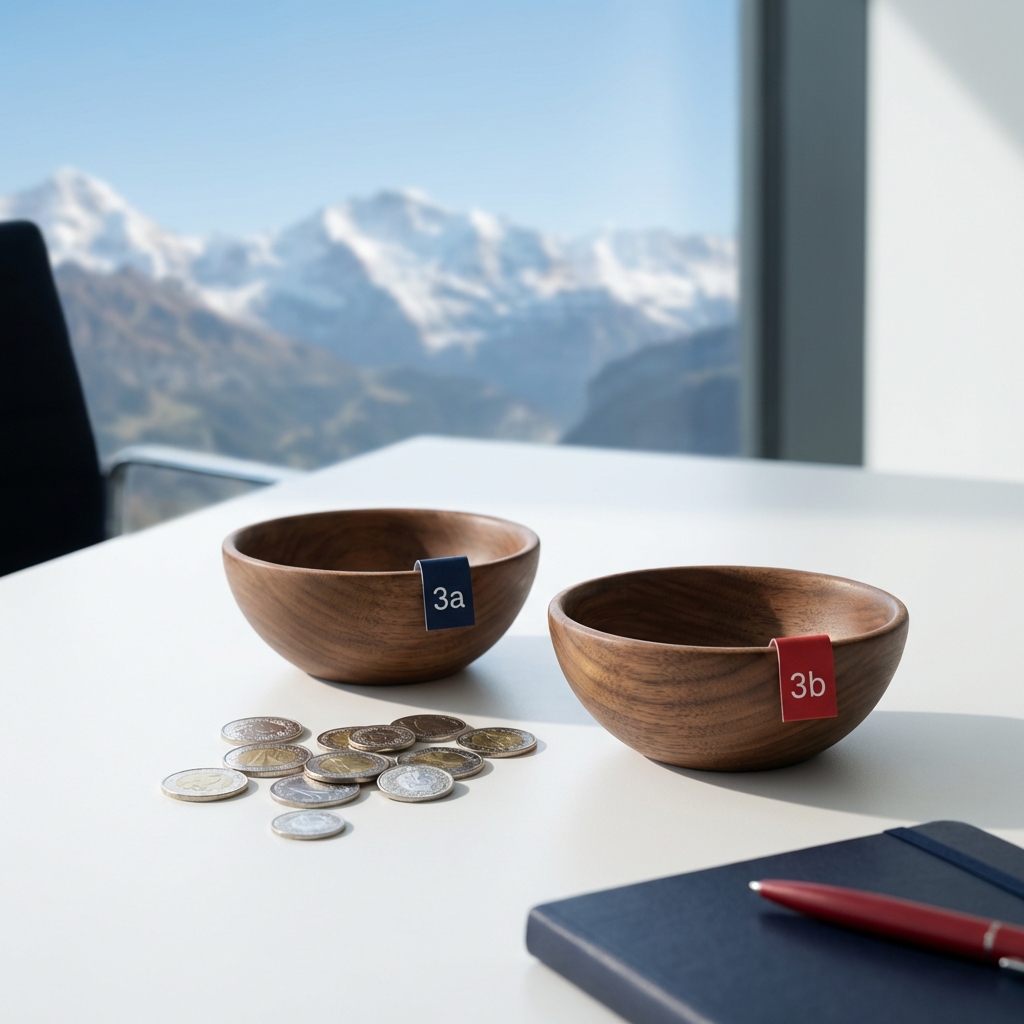
Here’s where the debate gets spicy. Your 3a capital is locked until you hit 60 or 65, depending on your birth year. You can only withdraw early for three reasons: buying your primary residence, leaving Switzerland permanently, or becoming self-employed. That’s it.
Interactive Brokers gives you instant access. Market crashes 40% and you spot a once-in-a-decade opportunity? Click, buy, done. Lose your job and need six months of expenses? Sell, transfer, survive. Want to compare liquid ETF investments to locked tangible assets? You have the flexibility to pivot.
The liquidity premium is hard to quantify but easy to feel. A friend of mine, let’s call him Marco, maxed out his 3a for five years, then got an opportunity to join a startup in Berlin. He needed CHF 50,000 for relocation and living expenses. His 3a? Locked. He had to beg his family for a loan while his retirement account sat fat and happy, completely useless in his moment of need.
The simulator can’t model that feeling of helplessness. It can’t put a price on being able to say yes to an opportunity or cover an emergency without paperwork and penalties.
The Reinvestment Trap
The CHF 20,000 advantage assumes you invest the tax saving immediately and never touch it. But behaviorally, that’s nearly impossible for most people. The tax saving arrives months after your contribution, in a lump sum that feels disconnected from your disciplined monthly investing.
One approach: automate the reinvestment. Set up a standing order to invest your expected tax saving into your IBKR account the moment your Steuererklärung is filed. But even this requires discipline most people lack. The money sits in your checking account, whispering sweet nothings about kitchen renovations.
Financial advisors love the reinvestment assumption because it makes their recommendations look brilliant. But they’re not the ones watching CHF 1,814 disappear into a new sofa.
Canton Roulette: Why Your ZIP Code Matters
The simulator includes commune-level marginal rates for a reason. Your canton of residence fundamentally changes the 3a calculus.
In Zurich, a high earner faces marginal rates approaching 40%. That CHF 7,258 contribution saves you nearly CHF 3,000 in taxes. The 3a advantage grows substantially.
In Zug, where rates are lower, the benefit shrinks. In Geneva, the progressive tax structure means the advantage peaks at specific income thresholds, then plateaus.
Worse, withdrawal taxes vary dramatically. Vaud (VD) only allows two accounts to be withdrawn separately, not five like most cantons. This destroys the multi-account withdrawal strategy that minimizes progressive tax on withdrawal. The simulator caught this nuance, most advice online gets it completely wrong.
Your Steueramt (Tax Office) doesn’t care about your financial optimization. They care about their rules, and those rules change based on your four-digit postcode.
The Five-Account Myth
Online forums obsess over opening five separate 3a accounts to stagger withdrawals and reduce progressive tax. The strategy works like this: instead of withdrawing CHF 400,000 in one year (taxed at a brutal rate), you withdraw CHF 80,000 over five years, staying in lower tax brackets.
But the simulator’s creator discovered something critical: Vaud only permits two separate withdrawals. Not five. Not three. Two. If you live in Lausanne and carefully built five accounts over fifteen years, you’re in for a nasty surprise when you try to access your money.
This kind of detail never appears in generic 3a advice. It’s the difference between optimizing your strategy and watching your optimization evaporate because you didn’t read the fine print in French.
When 3a Wins, When It Doesn’t
- You reinvest every franc of tax savings immediately and consistently
- You stay in Switzerland until retirement (or leave permanently and accept the withdrawal tax)
- Your marginal tax rate exceeds 25% and your canton allows multi-account withdrawal strategies
If any of those conditions fail, the advantage collapses.
- You value liquidity above all else
- Your income is moderate (marginal rate under 20%)
- You might need the capital before retirement
- You live in a canton with restrictive withdrawal rules
- You have the discipline to invest in a taxable account without the “lockbox” forcing function
The security implications also matter. Evaluating the security implications of direct brokerage access reveals that IBKR accounts lack the Swiss banking protections many assume exist. Your 3a is sheltered by Swiss pension law. Your IBKR account is governed by different rules entirely.
The Verdict
After running the numbers ten different ways, the answer isn’t clean. The simulator shows a CHF 20,000 advantage for 3a under perfect conditions. But perfect conditions rarely exist in Swiss financial life.
If you’re a high earner in Zurich with ironclad discipline and zero chance of leaving Switzerland before retirement, max out your 3a. Open multiple accounts. Automate your tax saving reinvestment. Never look back.
If you’re an expat on a five-year timeline, or someone who values flexibility, or your income fluctuates, or you live in Vaud, skip the 3a for now. Invest directly through IBKR, keep your liquidity, and accept that you’re paying for freedom.
The real answer? Do both. Contribute enough to 3a to get the employer match if you have one, then direct the rest to IBKR. You get some tax benefit while preserving optionality.
Your 11 PM dilemma doesn’t have a universal answer. But now you have the actual math, not the napkin version. And in Switzerland, the difference between napkin math and reality is exactly CHF 20,000.
Next Steps: Run your own numbers using the interactive simulator at laurentdellanegra.github.io/pillar-3a-simu. Input your actual commune, marginal rate, and investment timeline. See how the numbers shift. Then, and only then, make the call that fits your actual life, not some generic financial advisor’s spreadsheet.