
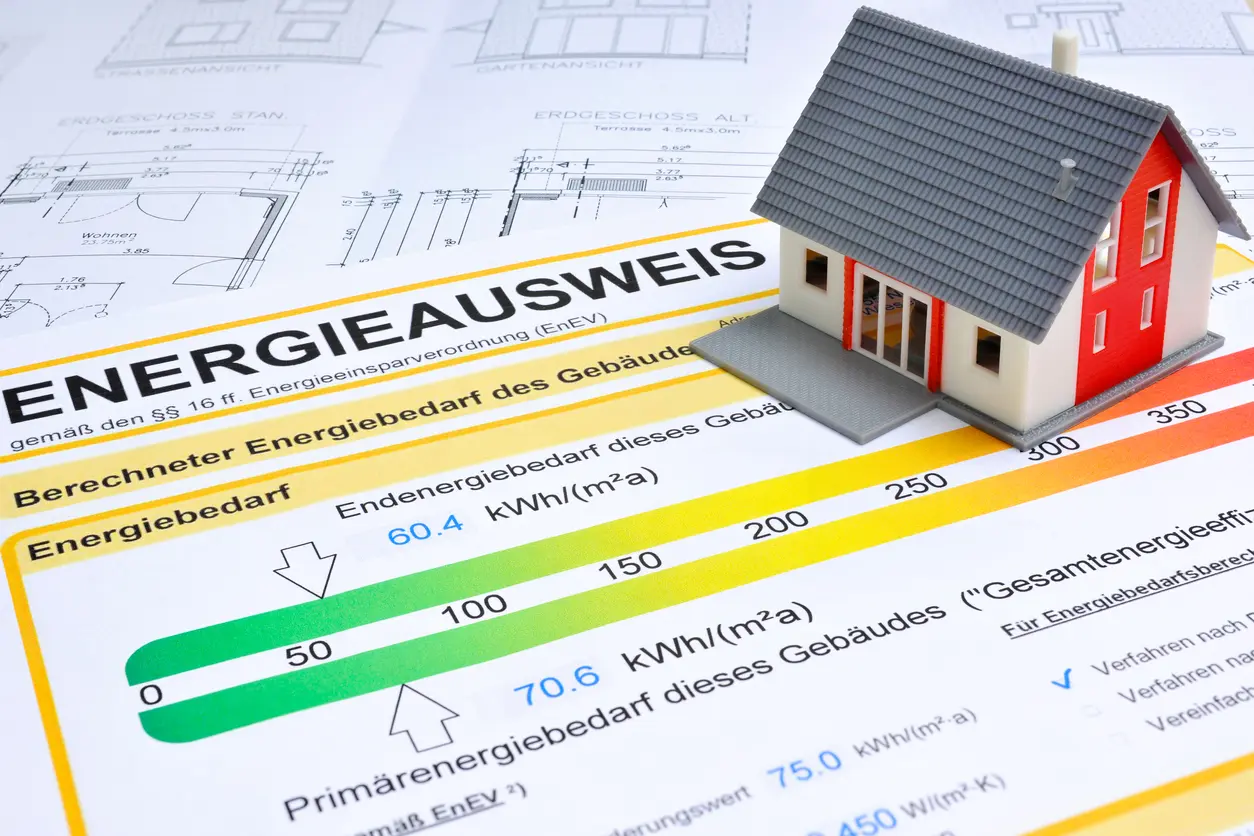
The Energy Certificate Trap: Why May 2026 Will Cost German Homeowners Thousands
Picture this: You’ve owned your Berlin Altbau (old building apartment) for eight years. Your tenant wants to renew their lease for another three. You’re about to sign when your Hausverwaltung (property management) calls, “We need a new Energieausweis (energy certificate) before any renewal. That’ll be €800 and three weeks’ wait.” Welcome to Germany’s latest bureaucratic masterpiece, arriving May 2026.
The energy certificate, long dismissed as that annoying piece of paper you needed for sales and new rentals, just became your new financial headache. Thanks to the EU’s revised Gebäuderichtlinie (Building Directive), Germany is implementing rules that will trap thousands of unsuspecting property owners in fines, delays, and unexpected costs. And unlike most German regulations that give you years to adapt, this one has a hard deadline that will punish procrastination.
The €10,000 Wake-Up Call: What Actually Changes
Let’s cut through the official announcements and get to what matters. From May 29, 2026, three major shifts hit German property owners:
First, the familiar A+ to H scale vanishes. New certificates use a simplified A to G ranking, where Class A is reserved exclusively for Nullemissionsgebäude (zero-emission buildings) and Class G captures the bottom 15% of buildings nationwide. Your 2018 certificate showing a respectable C+? Still valid for its full 10-year term, but the moment you need a new one, you’re on the new scale, and you might not like where you land.
Second, the certificate requirement expands dramatically. Previously, you needed one for sales, new rentals, and new leases. Now, you’ll need a valid Energieausweis for lease renewals with existing tenants. Planning to renew that five-year contract in June 2026? No certificate, no legal renewal.
Third, major renovations trigger the requirement. If you’re touching more than 25% of your building envelope or renovating more than 25% of the property value, you’ll need a current energy certificate. That ambitious façade renovation you’ve been planning? It just got more expensive.
The penalty for ignoring this? Up to €10,000 in Bußgelder (fines) under the Gebäudeenergiegesetz (Building Energy Act, GEG). And here’s the kicker: “I didn’t know” isn’t a defense. The law explicitly states that ignorance doesn’t protect you from penalties.
The Two-Party System: Bedarfsausweis vs. Verbrauchsausweis
German bureaucracy loves its either/or scenarios, and energy certificates are no exception. You have two options, and choosing wrong costs you money and accuracy.
The Bedarfsausweis (demand-based certificate) calculates your building’s theoretical energy needs based on construction, insulation, heating system, and building automation. It’s independent of whether your tenant heats at 19°C or 25°C, making it more reliable for comparing properties. For buildings constructed before November 1977, it’s often mandatory. Expect to pay €600-1,200 and endure an on-site inspection.
The Verbrauchsausweis (consumption-based certificate) uses actual heating costs from the past three years. Sounds simpler? It is, almost insultingly so. Many owners report paying online services around €100 to input their annual utility bills and receive a PDF certificate within days. One property owner in the research noted they simply emailed gas bills to a provider and received a legally valid certificate without anyone ever visiting the property.
But here’s why that cheap option might bite you: The Verbrauchsausweis reflects actual usage, not building quality. Your 85-year-old grandmother heating only three rooms will show fantastic consumption. A family with three kids using every room will show terrible numbers, for the exact same building. As one energy advisor bluntly put it, this makes the certificate “complete nonsense” for accurately assessing building performance.
The Hidden Costs Nobody Mentions

Let’s talk real numbers. A Bedarfsausweis for a typical German Einfamilienhaus (single-family home) runs €800-1,500 depending on location and complexity. In Munich or Frankfurt, you’re looking at the higher end. In rural Saxony, maybe slightly less. But the certificate itself is just the start.
Many owners discover their buildings need preliminary assessments before an energy consultant will even issue a certificate. Missing insulation documentation? That’s another €300-500 for thermal imaging. Unclear heating system specifications? A technician’s report adds €200. And if your building has had piecemeal renovations over decades, expect the consultant to charge extra for the detective work.
The timing also hurts. Energy consultants are already booking 4-6 weeks out in major cities, and the May 2026 deadline will create a rush. Wait until April, and you’ll pay rush fees or miss critical sale/rental deadlines. Smart owners are booking their assessments now, securing current pricing and avoiding the bottleneck.
For those thinking, “I’ll just get the cheap online Verbrauchsausweis”, consider this: Banks increasingly scrutinize these certificates during financing. A suspiciously good rating based on low elderly occupancy might trigger deeper due diligence, delaying your sale. In a cooling property market, a trend we explore in our analysis of broader German real estate market trends, any friction can kill deals.
The Lease Renewal Trap: Your Existing Tenant Is Now a Problem
This is the change that will blindside most landlords. Under current rules, if your tenant of eight years wants to renew, you sign the paperwork and move on. After May 2026, you must provide a valid energy certificate before renewing.
Imagine your tenant’s lease expires in July 2026. You haven’t needed a certificate since you bought the place in 2015. Your old certificate expired in 2025. Under the new rules, you cannot legally renew until you obtain a new one, taking 3-6 weeks and costing €600+. Your tenant, meanwhile, might lose patience and find another apartment, leaving you with a vacant unit in a market where vacancy periods are stretching longer.
For landlords with multiple units, this becomes a logistical nightmare. You’ll need to track expiration dates across your portfolio and schedule assessments proactively. Property managers report this will add €50-100 per unit annually in administrative costs alone.
Renovation Trigger: When Your Modernization Plans Backfire
The 25% renovation rule sounds reasonable until you actually calculate it. Replacing windows on a 150 m² house? If that’s more than 37.5 m² of façade area, you trigger the certificate requirement. A new heating system costing €25,000 on a €100,000 property? That’s 25% of value, trigger.
The perverse incentive here is that owners might delay necessary energy improvements to avoid the certificate cost and hassle. One consultant noted clients asking to split renovations across calendar years to stay under the threshold, a strategy that might save €1,000 on a certificate but costs more in contractor mobilization and lost energy savings.
Action Plan: What to Do Before May 2026
The Bigger Picture: Why This Actually Matters
Beyond the bureaucracy and costs, these rules reflect a fundamental shift in how Germany treats buildings. Energy efficiency is moving from a nice-to-have feature to a core determinant of property value. In a market where offsetting rising energy prices has become a national obsession, a poor energy rating can slash your property’s marketability.
Properties in classes F or G may become unfinanceable for many buyers, forcing cash sales at deep discounts. Conversely, A- or B-rated buildings command premiums of €50-100 per square meter in heated markets like Munich or Berlin. If you’re considering purchasing a residential property, the energy certificate is now as important as the Grundbuch (land register) entry.
The EU’s goal is clear: force energy transparency to drive renovation decisions. Germany’s implementation is equally clear: make non-compliance expensive. Your choice is simple, spend €600 now or risk €10,000 later.
Bottom Line
May 29, 2026 isn’t a suggestion, it’s a cliff edge. The German property market already operates with the same efficiency as a Deutsche Bahn train, usually impeccable, until there’s construction on the line. This is construction on your financial line.
Check your certificate’s expiration date today. If it’s within the next two years, book an appointment next week. The €600 you spend now buys you peace of mind, legal compliance, and the ability to transact without delays. The €10,000 fine you avoid buys you something even more valuable: the right to keep complaining about German bureaucracy without becoming its next victim.
Because in Germany, the only thing more expensive than compliance is getting caught without it.