

The €68,000 Question: What Germans Actually Mean When They Talk About a ‘Good Salary’
You’re at a dinner party in Berlin-Neukölln. The wine is flowing, someone mentions their recent job switch, and suddenly the table splits into two camps: those who earn “gut genug” (good enough) and those who feel perpetually broke despite five-figure monthly deposits. This is the moment when you realize that in Germany, “good salary” is less about the number on your payslip and more about which Bundesland (federal state) you’re standing in when you read it.
The raw data sounds straightforward. The median salary for full-time employees in Germany hovers around €54,000 brutto (gross) annually, which translates to roughly €4,500 per month before the Finanzamt (Tax Office) takes its share. But here’s where German precision meets messy reality: that median means half the country earns less, half earns more. And if you’re gunning for the top 30%, what most would call “gut verdient” (well-earned), you’re looking at €68,000+ brutto.
Sounds clear, right? Not even close.
The Net Income Reality Check
Your Brutto (gross) salary is a fantasy number, a theoretical construct that exists only on paper and in LinkedIn humblebrags. What actually hits your Deutsche Bank account, your Netto (net income), is where the story begins. A €54,000 brutto salary in Steuerklasse (tax class) I leaves you with approximately €2,800 netto per month. In Steuerklasse III (married, partner earns less), that same gross salary becomes €3,300+ netto. That’s a €500 monthly swing based purely on your relationship status.
This is why Germans obsess over net figures. The Institut der deutschen Wirtschaft (IW) defines the “einkommensstarke Mitte” (high-earning middle class) as single-person households bringing home €2,805 to €4,673 netto monthly. Break past €4,673? You’re officially in the “relativ reich” (relatively wealthy) category, though tell that to anyone trying to rent a two-bedroom in Munich.
The regional cost-of-living data reveals brutal truths. Munich’s nominal income ranks 6th nationally, but after adjusting for the city’s eye-watering expenses, rents 24% above the national average, it plummets to 68th place in real purchasing power. Your €70,000 salary in Munich buys you less than €50,000 does in Heilbronn, which tops the real income ranking at €39,424 annually thanks to high local incomes and moderate living costs.
Location Is Your Salary’s Secret Multiplier
Let’s talk about that €3,000 netto salary everyone references. As a single person in a structurally weak region like rural Saxony-Anhalt, you’re living like royalty. Your Warmmiete (warm rent) might be €600 for a 100m² Altbau (old building) apartment. You shop at the local Edeka, take weekend trips to Prague, and still save €1,200 monthly.
Move that same €3,000 netto to Munich with a partner and toddler. Your Warmmiete for a 65m² apartment is €1,800. Kita (daycare) costs €400 monthly. Suddenly you’re shopping at Aldi, vacation means Lake Garda instead of Thailand, and your savings rate evaporates. You’re not broke, but you’re certainly not feeling “gut verdient.”
The data confirms this geographic lottery. Mecklenburg-Vorpommern’s median salary is €47,750, lowest in Germany. Yet residents there report higher life satisfaction than Berliners earning 30% more, because a €1,000 rent gets you a house with a garden, not a WG (shared apartment) room in Kreuzberg.
Industry: The Great Divider
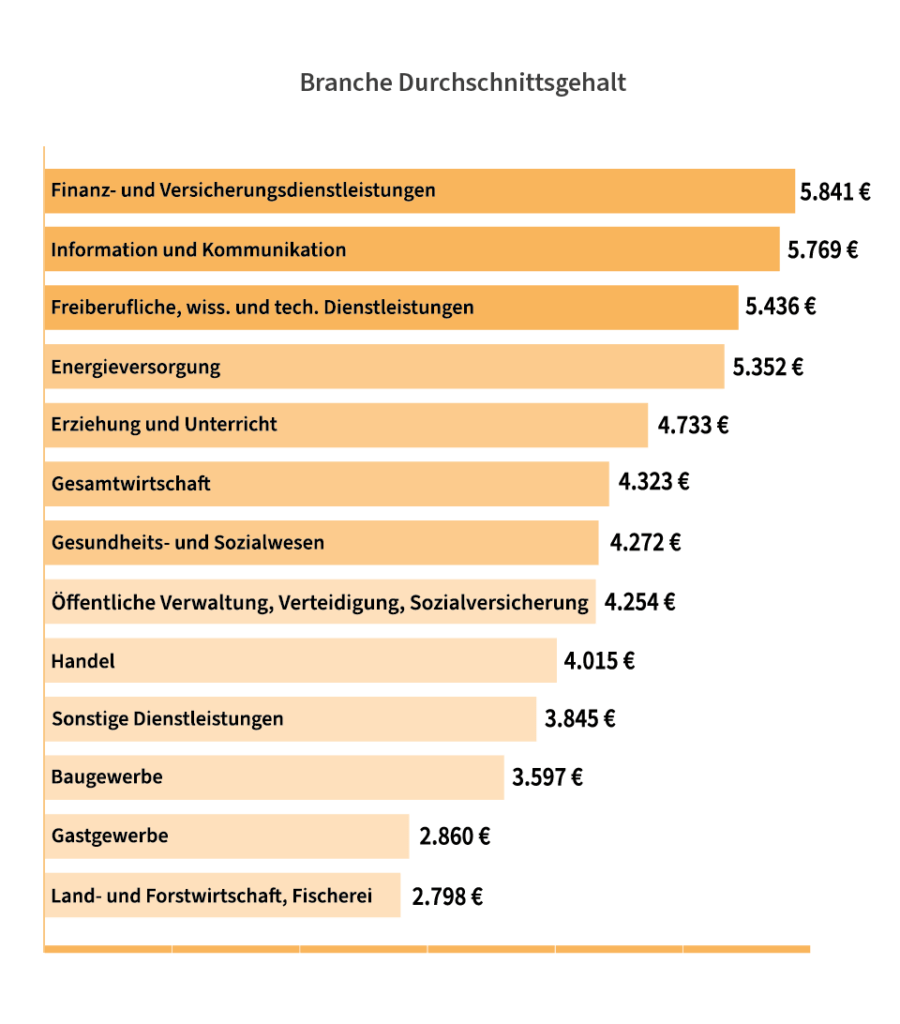
Your field of work creates chasms wider than the Elbe River. Finance and insurance employees average €5,841 brutto monthly. IT and communications hover around €5,600. Meanwhile, agriculture and forestry workers average €2,798, less than half. Hospitality? €3,185 brutto.
Precarious Sectors
Agriculture/Forestry & Hospitality workers often earn less than half the industry leaders. Education and Nursing require similar dedication but yield different outcomes.
High Earners
IT, Communications, Finance, and Insurance dominate the upper echelons of German payrolls regardless of experience level.
This isn’t just about education. A Pflegefachkraft (nursing specialist) with three years of Ausbildung (vocational training) might earn €3,200 brutto. A junior software developer with the same experience earns €4,500+. Both work full-time. Both pay taxes. But their definitions of “good salary” exist in parallel universes.
The gender pay gap compounds this. Women still earn 16% less brutto than men for the same hours, and when adjusted for qualifications and positions, the gap remains 6%. A woman in engineering needs to earn €72,000 to match her male colleague’s €68,000 in purchasing power.
The Inflation Elephant in the Room
This is where understanding the purchasing power of average monthly wages becomes critical. The numbers on paper mean nothing if they can’t command the same basket of goods.
When High Earners Feel Broke
Meet the €5,800 netto earner, the top 5% threshold. By IW definitions, this is “sehr gut” (very good). Yet many in this bracket report feeling financially squeezed. Why? Lifestyle inflation and hidden costs.
- Car Costs: A €1,500 monthly car lease for the obligatory BMW 5-Series.
- Housing: €2,500 Warmmiete for the “appropriate” penthouse.
- Lifestyle: €300 monthly gym membership at the premium studio.
- Vacations: Three Urlaube (vacations) annually because “that’s what people at this level do.”
Before you know it, managing lifestyle inflation alongside high earnings becomes your full-time job.
The Reddit threads are filled with this cognitive dissonance. “I earn €100,000 brutto but feel poor” posts inevitably reveal €2,800 monthly housing costs and €800 private kindergarten fees. Their salary is objectively excellent. Their financial choices make it feel mediocre.
The Single vs. Family Multiplier
Life stage transforms salary perception more dramatically than any tax class. A single 28-year-old earning €45,000 brutto in Leipzig is thriving. A 38-year-old Alleinerziehende (single parent) earning €60,000 in Hamburg is calculating which bills can be paid late.
The data is stark: a four-person family needs €3,880 netto monthly to reach middle-class status, according to IW Köln. That’s €46,560 annually after taxes, roughly €85,000 brutto for the primary earner in Steuerklasse III. And that’s just for the middle class, not “good.”
This is why the real net income implications of high-level promotions matter more than the gross headline figure. A €10,000 brutto raise might only yield €4,500 netto annually, €375 monthly. Enough to cover the rising Nebenkosten (utility costs) and little else.
Defining Your Personal “Good”
So what is a good salary in Germany today? The answer is infuriatingly simple: It’s the salary that lets you afford the life you want where you want to live, with enough left over to sleep at night.
If you’re single in Chemnitz, €42,000 brutto is comfortable. If you’re a family of four in Munich, €85,000 brutto feels tight. The median is a statistical artifact, your reality is built from Miete, childcare costs, commute expenses, and whether you need the car.
Survival Threshold
€1,850 netto monthly for singles, €3,880 for families. Below this, you’re statistically vulnerable.
Comfort Zone
€2,800-€3,500 netto for singles, €5,000-€6,500 for families. This is where most Germans report financial security.
Wealth Perception
€4,673+ netto for singles, €7,000+ for families. You can save aggressively, travel freely, and weather crises.
But these numbers only work if you control lifestyle inflation. A €70,000 salary with €2,000 monthly savings is better than a €100,000 salary with €200 monthly savings.
Actionable Steps for Salary Sanity
Stop comparing your Gehalt to national averages. Instead:
- Calculate your real hourly wage: Divide net monthly income by actual hours worked (including commute, overtime, mental load). A €60,000 job requiring 60-hour weeks pays less per hour than a €45,000 job with 35-hour weeks and Tarifvertrag (collective agreement) protections.
- Benchmark locally: Use the Destatis Gehaltsvergleich tool to see what your specific role pays in your Kreis (district), not just your Bundesland.
- Factor in hidden costs: That remote job paying €5,000 less might save you €6,000 annually in commuting, work clothes, and convenience meals.
- Track your savings rate, not your salary. If you can save 20-30% of net income, you’re winning, regardless of the absolute number.
The German obsession with ordnung (order) and fairness makes salary discussions feel like a competitive sport. But the only scoreboard that matters is your own. A €68,000 salary in Berlin with €1,200 rent and aggressive savings beats a €85,000 salary in Munich with €2,200 rent and zero financial buffer.
Your “good salary” isn’t defined by percentile rankings or industry reports. It’s defined by whether you can afford your Lebensmittel (groceries), pay your Miete, save for the future, and still enjoy the occasional Spontanurlaub (spontaneous vacation) without checking your Kontostand (account balance) first.
In Germany’s increasingly expensive landscape, that might be the rarest luxury of all.