

But here’s the thing about things that sound worry-free: someone else is usually getting paid to make you feel that way.
I’ve spent the past week digging into insurance-linked investment products in Austria and Germany, and the picture that emerges is less “worry-free” and more “worry-deferred.” Let me walk you through what these products actually cost, how they’re taxed, and whether you’d be better off just buying an ETF.
What Exactly Is the “Sorgenfreies Mixinvest”?
Before we dissect the costs, let’s understand what we’re dealing with. The EFS “Sorgenfreies Mixinvest” from Wiener Städtische (Vienna Insurance Group) is what the industry calls a fondsgebundene Lebensversicherung (unit-linked life insurance).
The pitch goes something like this: “You’re not buying life insurance, you’re investing in funds with a tax advantage.” And technically, that’s true. The product bundles investment funds with a small death benefit component, which gives it insurance status in the eyes of Austrian tax law. That status is the key selling point.
As Allianz Austria explains on their website, these policies are “a form of long-term capital investment combined with death benefit protection. The paid-in amounts are invested in funds. The goal is the chance of higher returns than a classic life insurance policy.”
And here’s the hook that gets most people: “Your profits are generally 100% KESt-free” (capital gains tax-free).
Sounds amazing, right? No 27.5% capital gains tax eating into your returns? Sign me up!
But as with most things in Austrian finance, the devil is in the details, and the details are buried in about 40 pages of product disclosures that nobody reads.
The KESt Illusion: Why “Tax-Free” Isn’t Free
Let’s talk about that tax advantage, because it’s the primary reason products like this get sold. In Austria, direct ETF investments are subject to KESt (Kapitalertragsteuer) of 27.5% on capital gains. Insurance-linked products, however, are structured differently: you pay a Versicherungssteuer (insurance tax) of 4% on premiums instead.
The pitch makes it sound like you’re avoiding a 27.5% tax. But here’s what the glossy brochure doesn’t prominently display:
- You pay 4% insurance tax on every premium, not on gains, on every single euro you contribute. Over 20 years of investing €200 monthly, that’s €1,920 in pure insurance tax before a single euro gets invested.
- The 27.5% KESt only applies to actual realized gains in a direct investment scenario. You’re not paying 27.5% on your contributions, you’re paying it on profits.
- You can structure direct ETF investing tax-efficiently by choosing accumulating funds, which defer tax burdens until sale.
One anonymous financial commentator on a popular investing forum put it bluntly: “27.5% less KESt on no profit makes no difference compared to paying KESt.” The point being: if the product’s returns are mediocre, the tax advantage means nothing.
Actually, there’s an even more basic problem with the marketing here. A detail that should concern anyone considering these products: “The mere fact that they don’t know the correct name for the securities tax in Austria should put you off”, noted one forum participant discussing the EFS materials. “Umgangssprachlich (colloquially) it might be fine, but from a supposedly serious financial institution, I expect them to know that KESt applies to both savings accounts and securities, only the rates differ (25% vs 27.5%).”
If the sales pitch gets basic tax terminology wrong, what are the odds the fee structure is crystal clear?
The Fee Onion: Layer After Layer of Costs
This is where insurance-based investments really hurt. Direct ETF investing has become astonishingly cheap, you can buy a global equity ETF with a total expense ratio (TER) of 0.20% per year or less. The costs are transparent, published, and comparable.
Insurance-linked products layer costs on top of costs like a financial lasagna:
Layer 1: Acquisition costs (Abschlusskosten)
In the first 5 years, a significant portion of your premium goes toward paying the salesperson’s commission. Depending on the structure, this can eat 3-5% of your total contributions. The Allianz product documents actually acknowledge this: “Due to the costs and taxes incurred, you accept that, particularly in the first years after contract conclusion, the value of the investment will be significantly below the contributions paid.”
Let me translate that corporate-speak: Your investment will be underwater for years. That €200 monthly payment? A good chunk of the first 2-3 years goes to commissions, not your future.
Layer 2: Insurance component costs
Even if you don’t have kids or dependents (which is a common scenario for buyers of these products), you’re paying for death benefit protection. One commenter on the EFS discussion noted the irony: “She doesn’t want children in the future”, yet she’d still pay for term life insurance she doesn’t need embedded in the product.
Layer 3: Admin fees (Verwaltungskosten)
Insurance policies charge annual administrative fees that are typically higher than brokerage account maintenance fees. These can run 1-2% annually in addition to fund fees.
Layer 4: Fund fees
The underlying funds within the insurance wrapper often have higher TERs than comparable ETFs. Actively managed funds (which these products favor) routinely charge 1.5-2.5% annually.
When you stack all these together, you’re looking at 3-5% annual costs before the market even moves. Direct ETF investing costs 0.20%.
Now, here’s where it gets really interesting. The German consumer protection organization calculated what happens when you compare different cost structures over 40 years: A product with 90% equity allocation and 0.2% costs yielded €179,823 in gains from €130 monthly contributions. An actively sold product with 70% equity allocation and 1.5% costs delivered just €79,807.
That’s not a rounding error. That’s €100,000 difference, the cost of “worry-free” investing.
Performance: Can Insurance Products Even Keep Up?
The defenders of these products will tell you that professional management outperforms passive ETFs. Let’s examine that claim.
The actively managed funds used in these insurance wrappers have consistently failed to beat passive benchmarks over the long term. The evidence is overwhelming and consistent across markets: after a decade, 85-90% of actively managed funds underperform their benchmark index.
For Austrian investors, there’s an even more pointed irony. The domestic ATX index has actually outperformed the S&P 500 on a euro basis over the past five years. According to Die Presse, despite Austria’s sluggish economy, the local capital market is thriving. The ATX crossed 7,000 points for the first time, with Bank Austria’s chief economist noting that companies are valued differently from the overall economy.
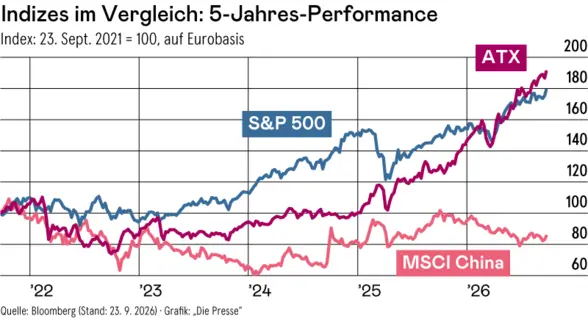
You could have captured that performance with a simple ATX ETF costing 0.3% annually. Instead, insurance products typically steer you toward expensive actively managed funds that have no better chance of beating the market than a coin flip.
Which raises a question worth asking: if these products are so good, why do they need armies of commission-driven salespeople to push them?
The Liquidity Trap: Your Money Is Locked In
Here’s a scenario nobody mentions in the sales pitch: What happens when you need your money?
With a direct ETF portfolio, you can sell within days and have cash in your account. The Austrian tax implications of investment strategies are manageable, and your invested capital remains accessible.
With an insurance-linked product, you face:
- Stornoabzüge (surrender charges): Allianz’s own documentation admits that early termination triggers surrender fees of up to €200, plus the loss of insurance coverage and potential tax disadvantages.
- Lock-in periods: These products are structured for 15-year minimum horizons. If you need the money at year 7, you eat the acquisition costs that haven’t been amortized yet.
- No partial withdrawals without penalty: While Allianz allows you to withdraw capital down to one annual premium, doing so while keeping the contract active still doesn’t fix the fundamental cost drag.
The financial industry loves these products because they lock in client relationships for decades. Once you’ve committed to a fondsgebundene Lebensversicherung, switching providers is complicated and expensive. Your capital becomes a captive audience.
As a comparison of fondspolizze (fund-linked policies) versus direct securities accounts notes, the nettopolizze (net tariff without commission) providers market ETF investment without ongoing KESt, but whether it pays off “depends heavily on investment amount, term, and ongoing costs.” The last time I checked, “it depends” isn’t the same as “it’s better.”
Who Actually Benefits From Insurance-Based Investments?
Let’s be brutally honest about where the money flows in these products:
- The salesperson: Gets a commission of 3-7% of your total contributions upfront
- The insurance company: Earns management fees, admin fees, and the spread between what they pay on your account and what they earn from their funds
- The fund manager: Charges 1.5-2.5% annually for mediocre performance
- You: Get “tax advantages” that in many realistic scenarios don’t overcome the cost drag
The Wiener Städtische, which sells EFS products, isn’t a charity. Neither is Allianz. These are insurance companies with shareholder obligations and sales targets. Their products are designed by actuarial teams who know exactly how to make the products look attractive while maintaining healthy profit margins.
I’m not saying insurance-linked investments are always terrible. There are specific edge cases:
- Ultra-long horizons (30+ years) where tax deferral compounds significantly
- Estate planning scenarios where the death benefit has genuine value
- People who cannot save without forced commitment (the lock-in becomes a feature, not a bug)
For the risks of passive market exposure without cost and tax optimization, these products might offer some benefits for very specific high-net-worth scenarios.
But for the typical person investing €200-500 monthly for retirement? The math simply doesn’t work in favor of insurance products.
What Should You Do Instead?
If you’re an Austrian resident considering these products, here’s my practical advice:
Run the numbers yourself.
The differences in ETF taxation between Austria and Germany are significant, and Austrian-specific structures matter. Use a comparison tool that accounts for KESt at 27.5% and compare it against the 4% insurance tax plus embedded product costs.
Demand transparency.
Ask the salesperson for the Effektivkosten (effective annual costs) of the product. Not the TER of the funds, the actual total cost including all insurance fees and commissions. If they can’t or won’t provide this number, walk away.
Check the illustrated performance scenarios.
Austrian insurance products are required to show potential returns. Compare those projections against simple ETF historical returns. Note how much of the “projected return” gets eaten by costs.
Consider a nettopolizze alternative.
The hidden fees in investment platforms are a real concern, but nettopolizze products at least eliminate the commission layer. These are still complex, but for those committed to insurance-wrapped investing, they’re the honest version.
Compare against a direct ETF portfolio.
Open a brokerage account at a steuereinfach (tax-simple) provider like Flatex, DADAT, or any Austrian bank. Set up an ETF Sparplan (savings plan) in a global equity ETF and one in an ATX ETF. You’ll have:
- Complete transparency on costs (0.2-0.3%)
- No lock-in periods
- Tax handling automated by your broker
- Long-term performance that historically beats 90% of actively managed funds
The Bottom Line
The “worry-free” in insurance-based investment products doesn’t describe your experience, it describes the insurance company’s experience. They’re worry-free about their margins, worry-free about client retention, and worry-free about meeting sales targets.
Every financial product involves trade-offs between cost, transparency, and flexibility. Insurance-linked investments in Austria trade all three away for a tax advantage that rarely justifies the sacrifice.
The Austrian financial system has many quirks, and navigating the hidden leverage and systemic risks in seemingly safe investments requires vigilance. But on this one, the math is clear: for most investors, most of the time, a simple ETF portfolio beats the “worry-free” alternative.
Your future self, the one with an extra €100,000 in their retirement account, will thank you for skipping the sales pitch.