

You sit down after work, a coffee in hand, and open a shiny online savings plan calculator. You type in the numbers: €1,500 per month, 32 years, 7% return. The screen flickers, and the algorithm spits out €2,142,616. Over two million euros. You lean back, a faint smile creeping onto your face. You’re a millionaire. At least, the spreadsheet says so.
Then the doubt creeps in. Has the German banking system just fed you a fantasy, or is this actually your ticket out of the daily commute, the office politics, the relentless rain we call summer?
I’ve been deep in the comments of a very popular German finance thread, and let me tell you, the debate around this “millionaire math” is heated. It’s a battleground of optimism, realism, and a healthy dose of German Sparsamkeit (thriftiness). Let’s tear this calculation apart, look at the actual data, and figure out if you should be booking your retirement condo in Bali or just buying a slightly nicer bike.
The Mechanical Heart of the Calculation
The calculator the original poster used doesn’t just pull numbers out of thin air. It uses a standard compound interest formula: K = K₀ · (1 + i/12)[12·t] + R · ((1 + i/12)[12·t] - 1) / (i/12).
Sounds terrifying, right? It just means your monthly €1,500 gets compounded monthly at an annual rate, gaining interest on interest. The tool from einfachberechnen.de even accounts for the 18.46% tax you’ll pay on ETF gains (thanks to the 30% Teilfreistellung, partial tax exemption for stocks) and a 2% annual inflation rate.
So, the math is mechanically sound. The algorithm works. But does the real world work that way? That’s where the trouble starts.
The 7% Assumption: A Walk Down History Lane
The most contested number in the whole debate is that 7% return. The user assumed this is the “MSCI World average.” We need to sharpen that pencil.
Historically, the MSCI World Index has delivered an annualized return of about 7.13% p.a. since its inception in 1969. That sounds great, until you look closer.
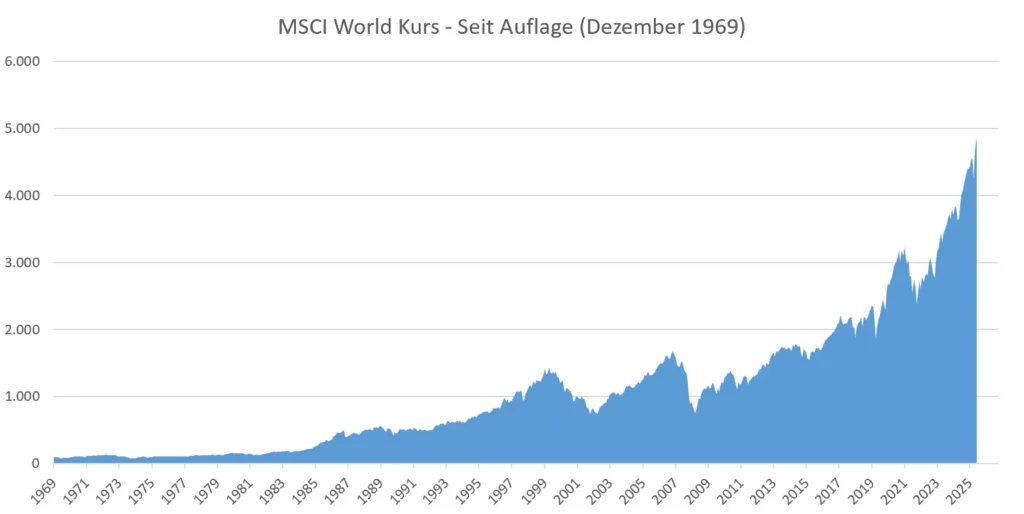
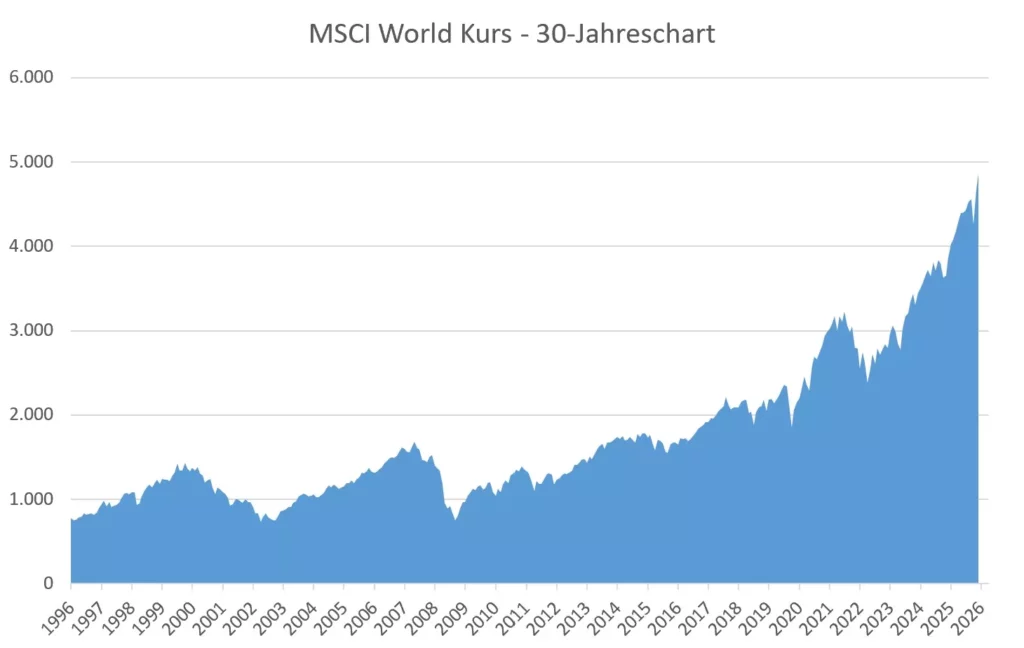
Here’s the catch, the “average” hides massive volatility. Check out the last 5 years (10.21% p.a.) versus the last 10 years (11.50% p.a.) versus the last 20 years (6.77% p.a.). The last 30 years? Only 6.31% p.a.
Here’s the data straight from msci-world.de:
| Zeitraum | Annualisierte Rendite p.a. |
|---|---|
| 5 Jahre | 10.21% |
| 10 Jahre | 11.50% |
| 15 Jahre | 9.08% |
| 20 Jahre | 6.77% |
| 25 Jahre | 6.21% |
| 30 Jahre | 6.31% |
| 40 Jahre | 6.99% |
| 50 Jahre | 7.90% |
| Seit Auflage (1969) | 7.13% |
Notice the pattern? Picking your start date matters immensely. If you started investing in 2001 (25-year mark), you barely got 6.2%. If you started in 2016 (10-year mark), you got a glorious 11.5%. The future? Nobody knows. But assuming a steady 7% is like assuming you’ll never get a flat tire on a road trip across Europe. It’s possible, but you’re probably lying to yourself.
The Silent Killer: Inflation and the Sparrate Adjustment Trap
The online calculator includes inflation, but it makes a subtle error that many commenters picked up on. It assumes you invest a fixed €1,500 for 32 years. But inflation means that €1,500 today is not €1,500 in 15 years.
One sharp commenter pointed out: “Wenn man schon mit 2% Inflation rechnet, sollte man auch die Sparrate anpassen.” (If you’re already calculating with 2% inflation, you should adjust the savings rate.)
Think about it. If inflation averages 2%, in 16 years, your €1,500 will only have the purchasing power of about €1,092 today. To maintain the same purchasing power of your savings rate, you’d need to increase it to nearly €2,100 per month by year 15, and almost €3,000 by year 30.
The calculator’s final number, “reale Kaufkraft (heute) von knapp unter 1 Mio €”, already accounts for inflation eating into the final pot. But it doesn’t account for the fact that you’ll be scraping to find that extra money each month just to keep your real savings rate constant. That’s a huge practical problem. Can you maintain a €1,500 savings rate for 32 years? Probably not without a serious career or a significant inheritance.
The Real Monster: Sequence of Returns Risk
The loudest criticism in the thread involves something called Sequence of Returns Risk. Uglier than the Abgeltungsteuer (withholding tax), and harder to avoid.
The calculator assumes a smooth, linear 7% return. If a market crash hits in year 30 of your 32-year plan, you’ll be fine, you’ve already built your massive pile. But if the market crashes 40% in year 2, that’s a disaster. You’re still building your capital, and a crash multiplies your small initial balance.
You can read more about the behavioral pitfalls that cause investors to panic-sell right at this moment in my deep dive on why German ETF investors panic sell at the worst moment. It’s a sobering read.
The MSCI World has historically recovered from massive drawdowns (the Dotcom crash in 2000, the 2008 Financial Crisis, and the 2022 inflation shock). But the timing matters enormously. A crash in your first few years can mean you end up with hundreds of thousands less than the calculator promises, even if the 32-year average return hits exactly 7%.
The Skin in the Game: Keeping the Discipline for 32 Years
Let’s be blunt. The math says €2.1 million is possible. But the real-life challenge is sustaining that €1,500 monthly Sparrate (savings rate).
Hats off to anyone who can. But life happens.
- You get married. (RIP, single-person budget)
- You have kids. (RIP, €1,500)
- You buy a house. (RIP, entire financial plan)
- You have a medical emergency.
- You lose your job for 6 months.
- You just get tired of watching your portfolio drop 15% in a year.
As one commenter bluntly stated: “Ja, Kinder und/oder Unterhalt lassen aus den 1500 schnell -500 werden.” (Yes, children and/or alimony turn that €1,500 into -€500 real quick).
Furthermore, if you’re looking for early retirement (FIRE), doing this math in your 30s is different than doing it in your 50s. Another user put it sharply: “Mit 67 Millionär sein ist unendlich einfach… aber mit 40 1-2 Millionen haben, dann wenn man noch ‘jung und knackig’ ist. Das ist ein ganz anderes Game.” (Being a millionaire at 67 is incredibly easy… but having 1-2 million at 40, when you’re still young and fit. That’s a completely different game.)
If you’re interested in the more relaxed version of this, where you accumulate a nest egg early and then let it ride, check out this analysis on Coast FIRE in Germany and why your €225k still feels like a prison.
So, Is the Math Realistic? The Verdict
The Math (7%): Realistic as a historical average over very long periods. But it’s not a guarantee, and recent 20-30 year periods have returned closer to 6.2-6.7%.
The Calculator: Mechanically correct for a linear world. It accounts for taxes (though a simplified version) and inflation (on the final pot). But it ignores Sequence of Returns Risk, which is the biggest threat.
The Real Plan: You can absolutely become a millionaire in nominal terms. Possibly even in real terms (inflation-adjusted). But you must:
1. Adjust your Sparrate for inflation every year.
2. Stay invested through crashes (don’t panic sell!).
3. Understand that 7% is a hope, not a fact. Plan for 5-6% real return to be safe.
4. Survive 32 years without derailing your financial life. That’s the hardest part.
The user on r/finanzen was right to be skeptical. The calculator is a fantastic tool, but it’s not a prophecy. It’s a map, not the territory. You need to navigate the real-world roads of job security, unexpected expenses, and market volatility. And stay away from products promising easy riches, German Hebelprodukte (leveraged products) are the fastest route to ruin if you’re not careful.
Keep saving. Keep investing. But keep your expectations sharp. The millionaire math is a dream worth chasing, but treat it like a marathon, not a calculator sprint.