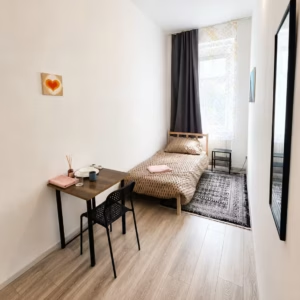

You’re refreshing Willhaben (Austrian classifieds platform) for the seventh time today, clutching your seventh coffee, when you see it: a 55m² Altbau in Neubau for €950. Your heart races. Is this a steal or daylight robbery? The truth is, you have no idea. And that’s exactly how Austrian landlords like it.
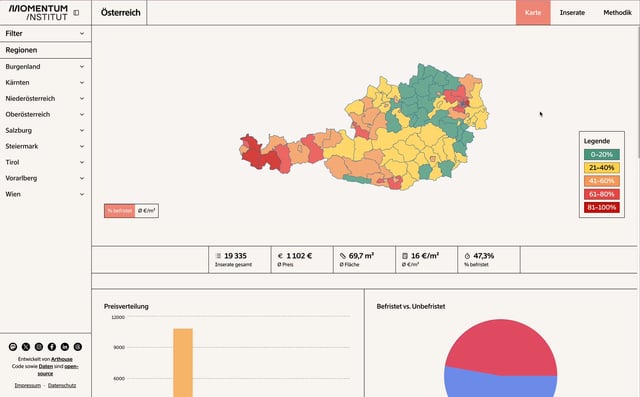
Here’s what changed everything: a Vienna-based developer built Mietmonitor.at, an open-source tool that scrapes Willhaben daily and finally gives tenants the data landlords have been hoarding for decades. Suddenly, you can see exactly how many fixed-term rentals cost more than indefinite ones, a phenomenon that makes zero sense until you understand the MRG (Mietrechtsgesetz – Tenancy Law) trap.
The Information War You Didn’t Know You Were Losing
Austrian rental markets run on asymmetry. Landlords know the Richtwertmietzins (reference rent) for every district. They know which buildings fall under MRG’s full scope and which don’t. They know that a three-year Befristet (fixed-term) contract in Innsbruck should theoretically be cheaper, but they also know most tenants won’t question it.
The Mietmonitor tool rips away this curtain. By scraping thousands of listings, it exposes patterns that individual apartment hunters could never spot. One user noticed something bizarre: in Innsbruck, the tool showed 46% of listings as Unbefristet (indefinite), yet everyone he knew had only fixed-term contracts. The explanation? Most indefinite rentals come from gemeinnützige (non-profit housing associations) with price-capped rents under MRG, while private landlords offering fixed-term deals operate in the wild west of “market pricing.”.
Why Fixed-Term Rentals Sometimes Cost More (And Why That’s Backwards)
Logic suggests a Befristet contract should be cheaper. The tenant accepts instability, the landlord gets flexibility. Under MRG, that’s actually the rule, there’s supposed to be a Befristungsabschlag (fixed-term discount). But here’s what the data reveals: many fixed-term listings on Willhaben come from private owners of Einliegerwohnungen (granny flats) in single-family homes, which are exempt from MRG’s termination protection.
These landlords charge premium rates because they can. Meanwhile, the indefinite contracts are mostly from housing associations bound by strict price controls. The result? A statistical illusion where fixed-term appears more expensive, but you’re really comparing two different markets that happen to share a platform.
How to Weaponize This Data in Negotiations
Walking into a Besichtigung (viewing) armed with Mietmonitor stats changes the dynamic completely. Here’s the playbook:
1. Demand the MRG classification. Ask directly: “Unterliegt diese Wohnung dem MRG-Vollanwendungsbereich?” (Does this apartment fall under full MRG scope?) If yes, pull up the current Richtwerte: Vienna €6.67/m², Tyrol €8.14/m², Vorarlberg €10.25/m². For a 70m² Vienna flat, that’s €467/month reference rent, anything above needs justification.
2. Counter the “market rate” argument. When landlords say “Das ist der Marktpreis” (That’s the market price), show them printed Mietmonitor distributions for that district. If their €950 listing is 40% above comparable offers, they’re not defending market value, they’re defending hope.
3. Expose the fixed-term premium. If it’s Befristet, calculate what the rent should be with the statutory discount. The FreeFinance guide explains discounts of 25% for Category B and 50% for Category C from the Richtwert. Use that gap as leverage: “Ich sehe hier, dass befristete Verträge in diesem Bezirk durchschnittlich 15% unter unbefristeten liegen. Ihr Angebot liegt 20% drüber.”.
What the Numbers Actually Show (And Where They’re Heading)
The tool’s current version is basic, just Befristung and price comparisons, but the developers are adding historical trends, affordability metrics, and multi-platform data. One commenter suggested tracking how long listings stay online, which would reveal market heat: “If flats in Leopoldstadt sit for 30 days but Favoriten listings disappear in 48 hours, you know exactly where you have bargaining power.”.
Regional patterns already emerge. Salzburg’s Richtwert is €9.22/m², but Mietmonitor shows private listings averaging €14-16/m². That’s not market forces, that’s landlords testing what they can get away with from unsuspecting expats who think Salzburg is just expensive.

The Caveats: Data Is a Weapon, Not a Magic Spell
Before you storm into negotiations, understand the limitations:
These are asking prices, not transaction prices. The tool’s creator admits this explicitly. A listing at €1,200 might close at €1,050 after negotiation. The data shows ambition, not reality. But ambition is still useful, if 50 listings in your target district all start at €1,200+, the floor is clear.
Willhaben isn’t the whole market. Housing association flats rarely appear there. The real deals happen through Genossenschaften (housing cooperatives) and direct applications. Use Mietmonitor to understand the private market ceiling, then hunt for the real gems elsewhere.
Legal knowledge completes the picture. MRG complexity determines your actual rights. A €600/m² “bargain” in a Category D building with no bathroom inside? That’s not a bargain, that’s a health hazard with a discount.
Your Next Move: From Data to Keys
-
Check your current rent. Plug your address into Mietmonitor. If you’re paying 30% above the district average for a comparable MRG-protected flat, research your legal rent reduction options (Mietzinsbeschwerde).
-
Set up alerts. The tool updates daily. Track specific districts for two weeks before you start hunting. You’ll spot which landlords drop prices (desperate) and which don’t (delusional).
-
Print comparisons for viewings. Not on your phone, on paper. Hand it to the landlord. It says: “I’m serious, informed, and will hold you to market standards.” Psychological warfare, Austrian style.
-
Learn the MRG basics. The FreeFinance guide breaks down Kategoriemietzins (Category A: €4.47/m², B: €3.35/m², etc.). You don’t need a law degree, just know which questions make landlords squirm.
The Viennese rental market isn’t efficient. It’s a game where one side has loaded dice. Tools like Mietmonitor don’t just level the playing field, they hand you the casino’s own security footage. Use it wisely, and that seventh coffee might be the last one you drink while apartment hunting.