
The Great Contribution Ceiling Lift: Why Your “Raise” Might Vanish
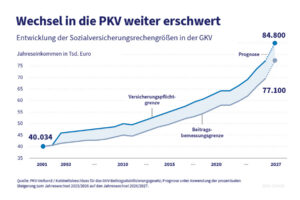
The most painful change is hiding in the Beitragsbemessungsgrenzen, the income ceilings up to which social contributions are calculated. Forgesetzlich Krankenversicherung (GKV), the ceiling is jumping from €5,812.50 to €6,375 per month. That’s a massive 9.7% increase in one year, far beyond the usual wage inflation adjustment, thanks to a policy shift aimed at stabilizing the healthcare system’s finances.
This hits a model high-earner making €80k brutto (gross) hard. In 2026, their GKV Krankenversicherung (health insurance) cost is capped at the old ceiling, in 2027, every euro of their salary up to €6,375 is subject to contributions. The result? Their health insurance costs rise by €590.64 annually, with long-term care insurance adding another €391.56 on top. The Pflegeversicherung (care insurance) childless surcharge also climbs from 0.6% to 0.9%, punishing the child-free demographic yet again.

Yes, tax rates shifted slightly downward and the Arbeitnehmer-Pauschbetrag (employee lump sum) went from €1,230 to €1,430. But those savings are pocket change compared to the waves of social contributions pulling you back out to sea. The net effect for this demo: €434.20 less in net income year-over-year.
But Wait, There’s a Plot Twist: The PFV Family on the Rise
Here’s where the reform gets spicy. Remember the private krankenversichert (private insured) high earner, the supposed rich guy of this story? He might actually walk away a “winner” on paper.
Take a family with one Hauptverdiener (primary earner) making €100k and a spouse earning €50k, with three kids, all privately insured. Since the employer contribution cap for PKV is tied to the GKV hypothetical maximum, the employer Zuschuss (subsidy) rises by €712.08. This happens because the government is forcing the employer’s subsidy cap upward. Additionally, Kindergeld (child benefit) climbs to €267 per month, giving a +€288 boost.
The numbers show this family gaining a net +€1,026.08 in cash terms versus 2026.
Before you throw your keyboard in frustration, here’s the spicy part: Inflation doesn’t care about your “nominal” win. With inflation hovering just under 3%, that same family takes a real-netto (real net) hit of €1,917.13 compared to last year. They’re making more euros but eating fewer of them.
Who Is Actually Paying for the Care Sector?
The political framing here is about fairness. But if you look closer, there’s a quiet structural transfer happening. The GKV high-earner is being pulled into an ever-larger contribution pool to shore up the system’s finances. The PKV family is being subsidized indirectly through higher employer subsidies, but they still face the cold wind of inflation without the same state support.
The system is no longer just “the rich pay for the poor.” It’s becoming “the young, childless, upper-middle-income professional pays for both the retirees and the privately insured family man.” It’s no shock that this is sparking debates about whether the Privilegien (privileges) of the PKV system are sustainable.
If you’re a high earner feeling the squeeze, you might want to check out our deep dive on the impact of Germany’s rising social contribution ceilings on high earners’ net income. It maps out exactly where those euros are disappearing to.
Rentenpunkte: The Silent Killer of Your Future Wealth
We often talk about the here-and-now. But one of the most toxic effects of these reforms is what they do to your future pension claim. The social security system works on Entgeltpunkte (earning points). Each year, you earn points based on your income relative to the average. With the vorläufiges Durchschnittsentgelt (provisional average earnings) rising to €53,452, wage earners who don’t get a pay raise are earning fewer points.
The model high earner loses 0.0434 Entgeltpunkte (2.8%) year over year. That might sound like decimal dust, but over a 40-year career, it compounds to a significantly lower Rente (pension). This flies under the radar because it doesn’t show up on your monthly payslip, it’s a silent deduction from your future standard of living.
It’s a dangerous shift: we’re asking the working generation to pay more now and accept less later. For those looking to fight back, exploring tax optimization strategies for high earners related to retirement planning might be a survival necessity, not just a “wealthy person’s game.”
The Politically Incorrect Winners: Are Retirees the Real Champions?
Here’s the part that gets the blood boiling. Those at retirement age are seeing their Rentenwert (pension value) increase from €40.79 to €42.52 per point (a +4.2% nominal bump). They don’t have to pay into the Beitragsbemessungsgrenze, they already paid their dues, and their health insurance contributions are actually lower now due to changes in the system.
While the working single loses €1,799.67 in real terms, the retiree receiving an average pension is likely seeing a small real-terms increase. Politically, it’s a smart move, pensioners vote. Financially, it’s a bitter pill for the younger generation who are realizing the “pay now, benefit later” contract is becoming a “pay now, maybe survive later” agreement.
The Steering Wheel: Should You Still Switch to PKV?
The reforms also tweaked the Versicherungspflichtgrenze (insurance obligation limit) to €84,150. If you’re thinking about switching to PKV to escape the GKV de facto “wealth tax”, the window is closing. The government has added a special boost of €3,600 to the limit, effectively making it harder for new people to exit the GKV.
Switching now means you’re taking a bet against future reforms that will likely only try to restrict PKV benefits further. You’re also betting against your own future income stability. The PKV family in our example looks good on paper, but it remains vulnerable to premium inflation that the state refuses to subsidize directly in the long run.
If you’re weighing the options, remember this: GKV offers the Sicherheit (security) of Spouse and kids being insured for free via Familienversicherung. The PKV model relies on actuarial soundness, and if your children get sick, or you get old, the costs can spiral. There’s a reason why the wealth distribution in Germany and structural financial inequality data shows the older generation holding the lion’s share of assets, they entered the system at a time when it was far more forgiving.
So, Who’s Actually “Winning”?
If we look strictly at the numbers from the user’s perspective:
- The GKV Single: Loses up to €1,800 in real purchasing power. Is increasingly being treated as an endless ATM for the social system.
- The PKV Family: Nominally wins slightly due to higher employer subsidies and Kindergeld, but loses €1,900 in real terms due to inflation. Their “win” is an illusion of the inflation gloss.
- Retirees: The quiet winners, consistently shielded from cuts and seeing pension increases that keep pace with or exceed inflation.
- The State: The undisputed winner. It is clamping down on the PKV/GKV divide, raising contribution ceilings, and transferring the burden onto high earners and the young, all without facing the political backlash that direct tax hikes would trigger.
- High Earners Above €8,850/Month: Nothing changes for them beyond a certain point, making lower “upper-middle” earners the true financial cannon fodder of this reform.
What Should You Actually Do?
First, don’t just look at your net income. Look at the Real-Netto-Einkommen (real net income), your tax bracket doesn’t matter if inflation eats the sandwich. If you’re not getting a 3% raise in 2027, the state is effectively giving you a pay cut.
Second, assess your risk. If you’re single, childless, and over the GKV ceiling, you are the wette losing demographic. If you’re in a PKV family, don’t get comfortable, check what happens when those children turn 14 and the care contributions shift.
Finally, treat not getting a raise as the crisis it is. For those whose salaries will remain frozen, the only defense is to actively reduce your taxable income through legal deductions and investments. In a system where your employer’s subsidy is rising regardless, staying in Germany and being insured is fine, but staying uninformed is financial suicide.
Welcome to the 2027 reality: the middle-class slugging match is on, and the state is the bookmaker. Place your bets wisely.