
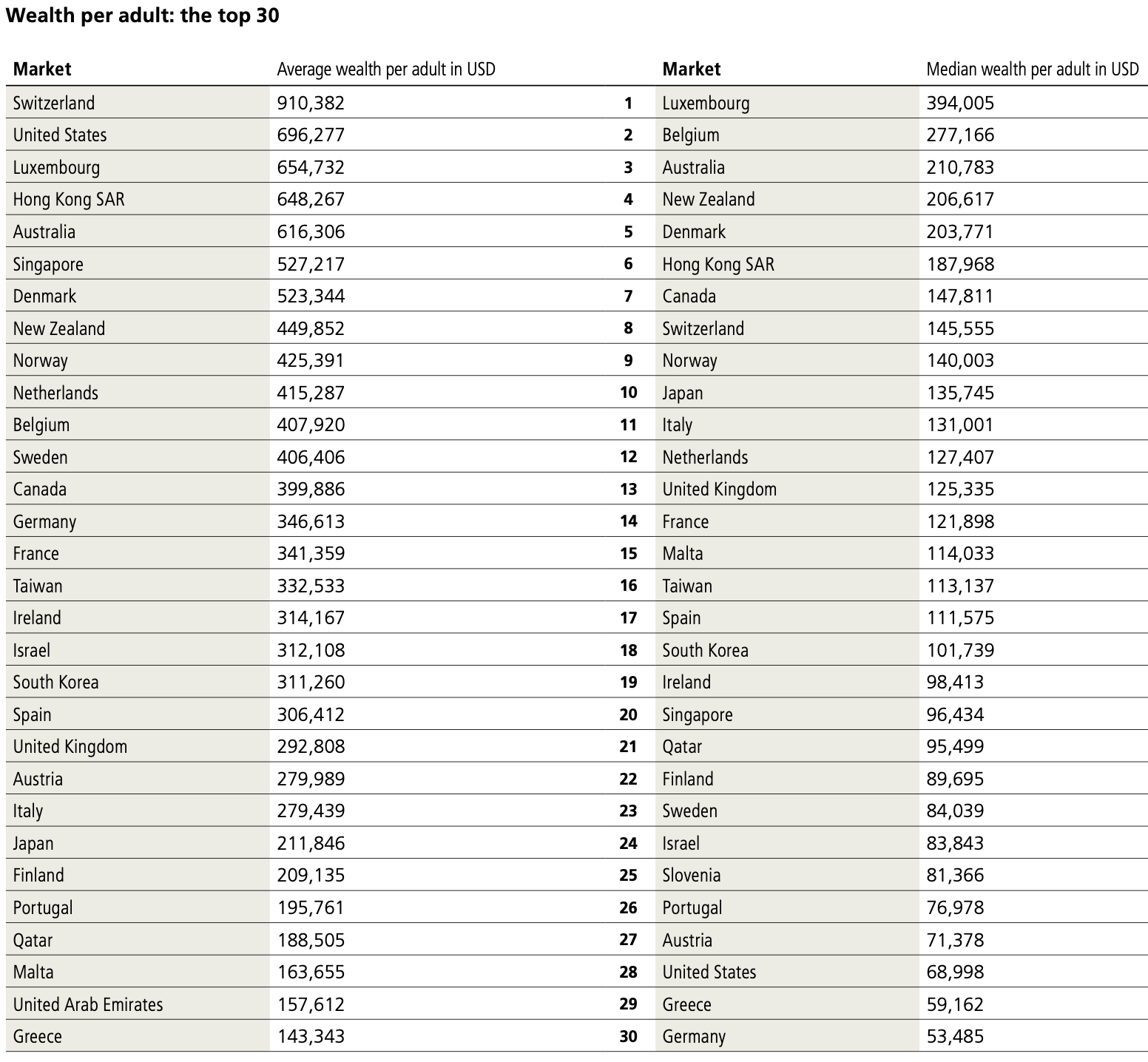
Let me start with a number that will ruin your morning coffee: 53,485 US-Dollar.
That’s the median net wealth of an adult in Germany, according to the freshly released UBS Global Wealth Report 2026. This puts Germany at rank 30 out of 30 countries in the report’s median wealth table. Behind Greece. Behind Portugal. Behind Slovenia.
Yes, you read that correctly. The largest economy in Europe, the export powerhouse, the land of the Mittelstand (small-to-medium enterprises) and the Autobahn, ranks dead last in median wealth among the countries surveyed. Meanwhile, the average wealth per adult in Germany sits at a respectable $346,613 (rank 14). The gap between those two numbers tells you everything you need to know about wealth in this country.
Let’s dig into what this actually means for your wallet.
The Median vs. Average Trap
Here’s the thing about averages: they lie. When UBS reports that the average German adult has $346,613 in net wealth, that number includes the 2.6 million US-dollar millionaires living in Germany. It includes the billionaires. It includes the family that owns the Mittelstand (small-to-medium enterprise) factory in Baden-Württemberg.
The median tells a different story. At $53,485, half of all German adults have less than that. The other half has more. But here’s the kicker, that number puts Germany at rank 30 out of 30 in the UBS Global Wealth Report 2026. Behind Greece ($59,162). Behind Portugal ($76,978). Behind Slovenia ($81,366).
Let that sink in for a moment.
The UBS report defines net worth as “the value of financial assets and real assets (principally housing) owned by private individuals, less their debts.” Private pension fund assets are included, but state pension entitlements (the gesetzliche Rentenversicherung (statutory pension insurance)) are not. This is a crucial distinction that explains part of the gap, but not all of it.
Why Germany’s Median Wealth Is So Low
The reaction to this data has been predictable. Many residents point to the high Abgabenlast (tax and social contribution burden) as the primary culprit. And they’re not wrong. Germany’s tax wedge on labor income is among the highest in the OECD. But that’s only part of the story.
Look at the ratio between average and median wealth. Germany’s average-to-median ratio is 6.48x, meaning the average is 548% above the median. Only the United States (10.09x) has a wider gap. This tells you that Germany’s wealth is heavily concentrated at the top, while the middle and bottom are comparatively thin.
The UBS report defines net worth as “the value of financial assets and real assets (principally housing) owned by private individuals, less their debts.” Private pension fund assets are included, but state pension entitlements (the gesetzliche Rentenversicherung (statutory pension insurance)) are not. This exclusion matters enormously in Germany, where the state pension system is the primary retirement vehicle for most people.
The Homeownership Factor
One of the most significant drivers of Germany’s low median wealth is the country’s exceptionally low homeownership rate. At roughly 52.8%, Germany’s homeownership rate is among the lowest in the developed world. Compare that to Greece at 70% or Spain at similar levels.
When you rent, you’re building your landlord’s wealth, not your own. The UBS report counts real assets like housing in its wealth calculations. If you don’t own property, you’re missing the single largest wealth-building asset class that most people have access to.
This isn’t just about housing policy, it’s about the fundamental structure of wealth in Germany. The Mietpreisbremse (rent control) and strong tenant protections make renting attractive and stable, but they also mean that wealth accumulation through real estate is concentrated among a smaller group of property owners.
The Inequality Ratio That Should Worry You
The UBS report includes a metric that deserves more attention: the average-to-median wealth ratio. Germany’s ratio of 6.48x means the average wealth is 548% above the median. Only the United States has a wider gap at 10.09x.
This ratio tells you that Germany’s wealth is heavily concentrated at the top. The top 3.9% of German adults hold roughly 46% of the country’s private wealth. Meanwhile, nearly 10% of German adults have less than $10,000 in net worth.
The report notes that “the lowest wealth tier is now nearly as big as the second-lowest” and that “if this trend continues, the bottom layers could flip before the decade ends.” This isn’t just a statistic, it’s a warning about the structural health of wealth distribution in Germany.
What This Means for Your Personal Finances
So you’re sitting there with your 53,485 US-Dollar median wealth (or less, or more), wondering what to do. The UBS data isn’t just a curiosity, it’s a roadmap for your financial strategy.
First, understand what’s counted. The report excludes state pension entitlements (gesetzliche Rentenversicherung (statutory pension insurance)). If you’re a typical German employee, your future pension claims represent a significant asset that isn’t captured in these numbers. But here’s the problem: those claims are not liquid, not inheritable in the same way as financial assets, and increasingly uncertain.
Second, recognize the homeownership gap. Germany’s low homeownership rate (52.8%) compared to countries like Greece (70%) or Spain (75%+) means that a huge portion of the population is missing the primary wealth-building vehicle that most other countries rely on. If you’re renting, you’re not just paying for housing, you’re missing out on the leveraged asset appreciation that homeowners benefit from.
Third, understand the tax and social contribution structure. Germany’s high Abgabenlast (tax and social contribution burden) means that even high earners struggle to accumulate wealth. The challenges of building wealth in Germany’s high-tax environment are real, and they’re reflected in the median wealth numbers.
What You Can Actually Do About It
The UBS data is sobering, but it’s not a reason to give up. Here’s what you can do to build wealth in Germany despite the structural challenges:
1. Invest in assets, not just savings accounts. The median wealth figure includes cash savings, which lose value to inflation. If you’re keeping your money in a Tagesgeldkonto (daily savings account) earning 0.5%, you’re falling behind. Consider an ETF-Sparplan (ETF savings plan) to participate in market growth. The challenges of building wealth in Germany’s high-tax environment are real, but not insurmountable.
2. Consider homeownership if possible. Yes, buying property in German cities is expensive. Yes, the Nebenkosten (ancillary costs) are brutal. But the data shows that homeowners in Germany have significantly higher net wealth than renters. If you can swing it, the long-term wealth building effect of property ownership is substantial.
3. Maximize your investable assets. The UBS report notes that “the share of liquid, investable assets has risen over the past ten years in selected key markets with high average wealth per adult.” This shift toward market-linked wealth means that those who participate in capital markets benefit disproportionately. If you’re not investing, you’re falling behind.
4. Understand what’s not counted. Your gesetzliche Rentenversicherung (statutory pension insurance) claims are not included in the UBS wealth calculations. For many Germans, these represent a significant future asset. But they’re not liquid, not inheritable in the same way, and increasingly uncertain. Don’t rely on them as your sole retirement strategy.
The Millionaire Creation Problem
Germany creates only 66 new US-dollar millionaires per day, according to the UBS report. That’s the third-worst rate among the 30 countries surveyed. The United States creates over 440,000 new millionaires per year, nearly half of the global total.
This isn’t just about the US having more people. It’s about the structure of wealth creation. In the US, stock market participation is widespread, 401(k) plans are common, and homeownership is higher. In Germany, the culture of investing is more conservative, with many people preferring Sparbücher (savings passbooks) and life insurance policies that offer minimal returns.
The report notes that “the share of liquid, investable assets has risen over the past ten years in selected key markets with high average wealth per adult.” This shift toward market-linked wealth means that those who participate in capital markets benefit disproportionately. If you’re not investing, you’re not just missing out, you’re actively falling behind.
What the Data Doesn’t Tell You
The UBS report has limitations. It doesn’t count state pension entitlements, which are significant in Germany. It uses US-dollar conversions, which can distort comparisons due to exchange rate fluctuations. And it measures wealth at a single point in time, not over a lifetime.
But the trends are clear. Global wealth grew by 10.8% in 2025, the fastest pace in years. The number of US-dollar millionaires expanded by nearly one million globally, more than 2,600 per day. And the wealth pyramid is shifting, with the lowest wealth tier shrinking and middle tiers expanding.
The question isn’t whether wealth is being created. It’s who gets to participate in that creation.
The Bottom Line
Germany’s rank 30 in median wealth is a wake-up call, not a death sentence. The data shows that the country’s wealth structure is heavily skewed toward the top, with a large middle class that owns relatively little in financial assets. But the data also shows that global wealth is growing, and those who participate in capital markets benefit.
The UBS report notes that “the share of liquid, investable assets has risen over the past ten years in selected key markets with high average wealth per adult.” This shift toward market-linked wealth means that the gap between those who invest and those who don’t will only widen.
If you’re living in Germany, the message is clear: the system isn’t designed to build your wealth through the state pension alone. You need to take control of your own financial future. Start an ETF-Sparplan (ETF savings plan), consider homeownership if possible, and understand that the median wealth number is a starting point, not a destination.
The UBS data shows that global wealth is growing at 10.8% per year. The question is whether you’re part of that growth or watching it from the sidelines. The median wealth number is a snapshot of where Germany is today. Where you end up depends on what you do next.