

Germany’s pension system just got its biggest shakeup since the Riester-Rente (Riester pension) flopped onto the scene two decades ago. The Bundestag has approved the Altersvorsorgedepot (retirement provision depot), and suddenly everyone from your Sparkasse advisor to that finance bro on TikTok is calling it a “revolution.” State-subsidized ETF investing! Up to €540 in free money! What could possibly go wrong?
Plenty, actually. And if you’re not paying attention, this “reform” could turn your retirement savings into a masterclass in how German bureaucracy extracts maximum pain from every good intention.
What the Altersvorsorgedepot Actually Promises
Let’s cut through the marketing fluff. Starting January 2027, you’ll be able to open a special depot and invest up to €6,840 per year in ETFs and funds, with the state chipping in subsidies. The basic structure is deceptively simple:
- Contribute €360 annually → get 50% state subsidy (€180)
- Contribute another €1,440 → get 25% subsidy (€360)
- Maximum basic subsidy: €540 per year
- Plus €300 per child (if you contribute at least €25)
- Plus a €200 “career starter” bonus if you’re under 25
Sounds generous, right? That’s what the Finanzlobby (financial lobby) wants you to think while they rebrand the same old complexity in a shiny ETF wrapper.
The Tax “Benefit” That’s Probably Just a Deferral
Here’s where it gets spicy. During the Ansparphase (accumulation phase), your investments grow tax-free. No capital gains tax, no Vorabpauschale (advance lump sum). Sweet deal. But the German state didn’t suddenly develop generosity, this is Steuerstundung (tax deferral) with a vengeance.
When you hit retirement and start withdrawing, the Finanzamt (Tax Office) comes knocking with its Günstigerprüfung (favorable tax assessment). If you’re a middle-income earner with a marginal tax rate above 20%, you’ll likely find that most of your “subsidy” is just taxes you would have saved anyway through the Sonderausgabenabzug (special expenses deduction).
Matthias Kirchhart, one of the few commenters who actually ran the numbers, explains it brutally: “Above €30 monthly contributions, the state isn’t really subsidizing you, it’s just deferring your tax bill. You get €0.25 in Zulage (subsidy), but you could have gotten €0.375 back through tax deductions. Net effect? You’re paying the state for the privilege of locking up your money.”
The Bundesfinanzministerium (Federal Ministry of Finance) will let you deduct contributions up to the Sonderausgaben-Höchstbetrag (special expenses maximum), but then claw it back during Auszahlung (payout). That 30% lump sum you’re allowed to withdraw at retirement? Fully taxed as income, even though it contains your already-taxed contributions. It’s like paying VAT on a used car, twice.
The 1% Cost Cap That’s Actually a Scandal
Professor Hartmut Walz, one of Germany’s sharpest financial watchdogs, calls the 1% cost cap “viel zu hoch” (way too high). And he’s being polite. The Swedish state fund AP7 Såfa charges 0.04-0.1% annually. That’s not a typo. Germany’s “reformed” system costs ten to twenty-five times more.
Why? Because the Finanzlobby apparently co-wrote the law. They can charge up to 1% on the Standardprodukt (standard product), and there’s no cap at all on their “freely designed” expensive alternatives. Walz calculates that this cost difference will destroy billions, maybe trillions, in citizen wealth over decades.
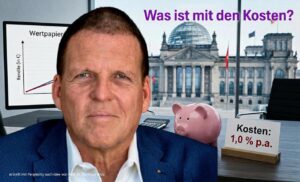
One commenter on Walz’s blog ran a 40-year scenario: €150 monthly at 9% returns. The state-subsidized product yields €490,000. A simple ETF without subsidies? €599,000. That “free” €540 per year cost him €109,000.
The financial industry is already salivating. KPMG’s industry analysis notes that with 40 million potential customers, even capturing a fraction of that 1% fee creates a “massive new market.” For them, not you.
Who Actually Wins Here?
Let’s be cynical, because Germany’s pension reforms demand it:
Families with multiple children
The Kinderzulage (child subsidy) can stack up, making this marginally better than going it alone. If you have three kids and a low marginal tax rate, you might actually come out ahead.
Low earners below 20% tax bracket
You might get real subsidy value, but good luck affording the contributions.
The under-25 crowd
That €200 bonus is nice, but it’s a one-time marketing gimmick to hook you early.
Everyone else
You’re probably better off with a normal ETF-Sparplan (ETF savings plan). The comparison of the new State Pension Depot versus traditional Riester plans shows that for average earners without kids, the math rarely works.
The self-employed, who’ve been screwed by the Rürup system for years, finally get access to subsidies, though the state subsidies available for self-employed retirement contributors remain less generous than for employees.
The Riester Exodus (If You Can Afford It)
Good news: you can transfer existing Riester-Verträge (Riester contracts) into the new system. Bad news: you have to navigate the same Vertriebsmaschinerie (sales machinery) that sold you those garbage products in the first place.
The transition isn’t automatic. Your insurance agent will call it a “historic opportunity” to sell you a new product with fresh Abschlusskosten (upfront fees). Many experts recommend waiting, let the dust settle, see which providers actually offer costs below 0.3% (the real sweet spot), and ignore the FOMO.
What You Should Actually Do
- Do nothing until 2027 Q2: Let the early adopters test the buggy systems. The Bundesfinanzministerium is still writing the FAQ page.
- Calculate your real marginal tax rate: If it’s above 20%, mentally subtract that from the promised subsidy. That’s your actual benefit.
- Demand cost transparency: Any provider charging above 0.3% effective costs is stealing from your retirement. The transition from guaranteed pensions to market-linked stock portfolio strategies only works if costs stay low.
- Consider splitting: Put €1,800 in the subsidized depot to max out the Zulage, then invest the rest in a normal ETF-Depot. Best of both worlds.
- Track the public option: If the state-run Standarddepot actually launches with Swedish-level costs, it could be a game-changer. But I’ll believe it when I see it.
The Verdict
The Altersvorsorgedepot solves the right problem, Germany’s over-reliance on expensive, guarantee-laden insurance products. But it solves it with a solution that’s 80% marketing and 20% substance. The €540 subsidy is real money, but the 1% cost cap, complex tax treatment, and lack of a true default option (Opt-out) mean most people would do better keeping it simple.
As Walz puts it: “The fact that the Finanzlobby is complaining so loudly is an unmistakably good sign for consumers.” But their tears are crocodile tears. They’ve already won the cost battle, and they’ll make billions selling “premium” versions to confused customers.
Your move? Open a normal ETF-Sparplan today. If the Altersvorsorgedepot proves its worth by 2028, you can always shift money then. But don’t let the promise of “free” money lock you into a system that costs you €100,000 in compound returns.
The German pension system operates with the same efficiency as a Deutsche Bahn train, usually impeccable, until there’s construction on the line. And right now, the entire track is being rebuilt. Wait for the dust to settle before boarding.