
CHF vs USD: The Currency Myth That’s Costing Swiss Investors Sleep

You’ve been there. It’s 11 PM in Zurich, you’re staring at your Interactive Brokers screen, finger hovering over the “Buy” button for Vanguard’s VT (Total World Stock ETF), and that nagging voice won’t shut up: “But it’s in USD. What if the dollar collapses?”
That voice has cost Swiss investors more in missed opportunities and unnecessary fees than any actual currency crash ever could. Here’s the truth that’ll let you sleep again: the currency your ETF is denominated in matters about as much as the language on your SBB ticket, it’s a convenience layer, not the actual journey.
The Paralysis by Analysis Problem
Walk into any Swiss Finanzforum (finance forum) and you’ll find the same question asked weekly: “Should I buy VT in USD or wait for a CHF-denominated version?” The anxiety is palpable. Swiss investors, notoriously conservative with their Kapital (capital), see that USD label and imagine their hard-earned Francs evaporating in a currency apocalypse.
But you’re not buying dollars. You’re buying tiny slices of nearly 10,000 companies, from Apple in California to Nestlé in Vevey (which, ironically, trades in multiple currencies itself). The USD is just the pricing language, not the underlying value.
Think of it this way: if I tell you a watch costs CHF 1,000 or USD 1,100, you’re buying the same watch. The number changes, but the object doesn’t. Global ETFs work identically.
Why Currency Denomination Is Smoke and Mirrors
When you buy VT through IBKR, you’re purchasing shares of companies that generate revenue in dozens of currencies. Toyota sells cars in yen, LVMH sells bags in euros, Microsoft sells software in… well, everything. The ETF’s USD price simply reflects the sum of those global revenues, converted to dollars for quotation convenience.
If the USD weakens 20% against the CHF, two things happen simultaneously:
1. Your VT shares drop 20% in USD terms when converted back to Francs
2. The underlying companies’ non-USD revenues become more valuable in USD terms, pushing the ETF price up
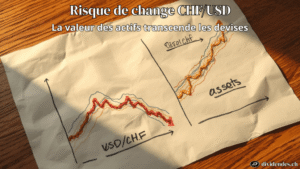
These forces largely cancel out. As one seasoned investor put it: “You can value those companies in USD or CHF or gold or bitcoin. The fact that VT is traded in USD has no bearing.” The currency is a measuring stick, not the thing being measured.
The Real Currency Risk (And Where It Actually Lives)
Real risk appears when:
- You invest in a single-currency bond ETF (like US Treasuries)
- You hold cash in foreign currencies
- The USD crashes so catastrophically it destroys the business models of US-exporting companies
That last point matters. If the dollar truly collapsed, say, losing 50% of its value overnight, American companies wouldn’t just sit there. Their costs, revenues, and valuations would convulse. As one analyst noted, “European companies almost crashed because their exports to the US became subject to tariffs. Imagine if those products became twice as expensive for the American market.”
But here’s the key: this risk exists whether you bought VT in USD, CHF, or Esperanto. It’s embedded in the companies themselves, not the trading currency.
The CHF-Hedged Trap: Why You’re Paying for Nothing
Swiss banks and asset managers, hello, UBS and Swissquote, love selling CHF-hedged ETFs. They pitch them as “currency-safe” options for conservative Swiss investors. What they don’t emphasize? You’re typically paying 0.10-0.25% extra in annual fees for that “protection.” On a CHF 100,000 portfolio, that’s CHF 250 yearly. Over 20 years, compounded, you’re giving up over CHF 12,000 in returns. For what?
For hedging against fluctuations that largely don’t affect your actual wealth. It’s like buying insurance against your watch’s price tag changing color. The underlying asset remains unchanged.
Worse, hedging introduces its own costs and tracking errors. The hedging instruments need constant rebalancing, creating taxable events and slippage. Your Steuererklärung (tax declaration) becomes more complex, and your returns drift from the index.
The Swiss Investor’s Playbook: What Actually Matters
1. Quellensteuer (withholding tax) efficiency
VT, despite its US domicile, is actually tax-efficient for Swiss investors thanks to the US-Switzerland tax treaty. You reclaim 15% of the 30% US withholding tax on dividends. Many CHF-domiciled funds don’t offer this advantage.
2. Total expense ratio
That 0.07% TER on VT beats most CHF-hedged alternatives hands down. Over decades, this difference dwarfs any currency fluctuation impact.
3. Trading volume and spreads
VT’s massive USD-denominated trading volume means tighter bid-ask spreads. You’ll lose less money entering and exiting positions, a real, measurable cost that currency fretting ignores.
4. Your actual currency exposure
If 90% of your net worth is already in CHF (salary, pension, property), having equity exposure in a different currency is diversification, not risk. Your problem isn’t too much USD exposure, it’s too much CHF concentration.
The Verdict: Stop Optimizing the Wrong Thing
After analyzing the data and watching Swiss investors make this mistake for years, here’s my take: Buy VT in USD through IBKR and sleep soundly.
The currency denomination is a technical detail, like whether your broker statement arrives via email or post. It has zero impact on your long-term wealth creation.
What actually matters:
- Staying invested instead of waiting for “the right currency moment”
- Keeping costs low (TER, spreads, currency conversion fees)
- Maintaining diversification across sectors and geographies
- Optimizing taxes through proper Quellensteuer reclamation
If you’re still anxious, here’s a compromise: split your equity allocation 50/50 between VT (USD) and a CHF-denominated global ETF like Vanguard’s VWRL (traded on SIX Swiss Exchange). You’ll pay slightly higher fees on the CHF portion, but the psychological comfort might be worth it. Just recognize you’re paying for peace of mind, not actual risk reduction.
When You Actually Need CHF Hedging
There’s one scenario where CHF-hedged ETFs make sense: bond allocations. If you’re holding global bonds for stability, currency swings can overwhelm the tiny yields. A CHF-hedged global bond ETF protects your capital’s purchasing power for Swiss liabilities.
But for equities? You’re already riding the volatility tiger. Currency fluctuations are just extra noise on a signal that’s already blasting at maximum volume.
Final Word: The Swiss Banking System Comparison
The Swiss banking system operates with the same reliability as an SBB train, usually impeccable, until construction slows the line. Currency hedging is that construction: unnecessary delays on a journey that would have arrived on time anyway.
Your VT shares represent real companies making real products. They’ll adapt to currency changes by adjusting prices, sourcing, and operations. They survived the 1970s inflation, the 2008 crisis, and COVID. They’ll survive USD/CHF moving from 0.78 to 0.85 or wherever it goes next.
Stop staring at currency charts. Start focusing on what you control: costs, diversification, and time in the market. The rest is just noise that sells expensive financial products to paranoid investors.
Now go buy that VT position. Your future self will thank you, for the returns, and for the sleep.