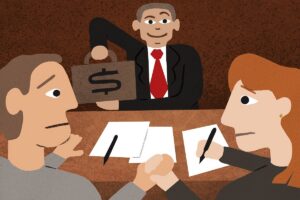


Your bank advisor smiles warmly across the desk, slides another brochure across the polished wood, and assures you this pension product is perfect for your situation. You trust them. Why wouldn’t you? They’ve known your account since you opened your first Girokonto (checking account) in Germany. But here’s what they didn’t mention: that trust is costing you the equivalent of a new Porsche 911. Every. Single. Time.

The numbers are brutal. German investors lose a staggering €98 billion annually to advisor commissions and hidden fees, money that doesn’t vanish into thin air but flows directly into the well-oiled wealth machine of banks, insurance companies, and their salesforce. And the most infuriating part? Most victims never realize they’ve been fleeced until decades later when they check their retirement balance and wonder why it feels… anemic.
The Compound Interest Heist Nobody Talks About
Let’s cut through the financial jargon and look at what actually happens to your money.
Imagine you’re disciplined. You invest €200 every month for 40 years. That’s €96,000 of your hard-earned cash. If you park it in a low-cost ETF through an online broker and earn a modest 6% annual return, you’ll retire with €398,000. Not bad.
Now walk into your local Sparkasse (savings bank) and let their advisor sell you a similar product. That same €200 monthly investment, now burdened with 1.5% annual fees, delivers only €300,000. You just lost €98,000. At 2% fees, a common reality with German insurance-wrapped products, you’re left with €270,000. That’s €128,000 evaporated.
The advisor calls it “a small management fee.” You should call it what it is: a 25-30% wealth tax that funds their Mercedes lease.
John Bogle, the legendary founder of Vanguard, ran these numbers to their logical conclusion. He found that doubling fees from 1.1% to 2.2% slashes your final wealth by 65% over a 40-year horizon. The math is merciless. Fees compound just like returns, but they compound against you.

Why Germans Keep Falling for the Same Trap
Here’s where it gets weirdly German. After the 2008 financial crisis, trust in the financial industry collapsed. But trust in individual advisors actually increased. It’s what researchers call the “Vertrauensgut” (trust good) paradox, when you can’t evaluate quality yourself, you cling to personal relationships like a life raft.
Your brain tells you: “All those other suckers got bad advice, but my advisor knows me. They wouldn’t steer me wrong.” Except they do. Not because they’re evil, but because the system is engineered to reward selling, not optimizing your wealth.
Andreas Hackethal from Goethe University Frankfurt puts it bluntly: “The problem with financial advice is that it’s a trust good. The person receiving the advice cannot assess whether the quality was high. It only becomes clear many years later whether this match actually worked.”
By the time you realize the match was a mismatch, your advisor has collected their commissions and moved on to fresher prey.
The Rentenversicherung (Pension Insurance) Scam Hiding in Plain Sight
Want to see this wealth drag in its purest, most diabolical form? Look no further than Germany’s beloved Rentenversicherung (pension insurance) products.
These sound brilliant in theory: you commit to monthly payments, the insurance company invests your money, and you receive a pension for life. The sales pitch writes itself. “Sicherheit für’s Alter” (security for retirement). Who could argue with that?
The reality? Studies show investors receive back only 85-90% of their total contributions. The rest, 10-15% of everything you paid in, vanishes into the commission and fee ecosystem.
One commenter in the financial community calculated that after 35-40 years of paying into these products, you could die four months after retirement begins and your heirs get… nothing. Zero. All those hundreds of thousands of euros? Poof. The insurance company keeps them. It’s not a pension, it’s a lottery where you bet on your own longevity, and the house always wins.
The Commission Architecture That Rewards Bad Advice
Here’s how the sausage gets made. Your Sparkasse or Deutsche Bank advisor doesn’t work for you, they work for their employer. They have sales quotas. They receive higher commissions for pushing in-house products (looking at you, Deka funds). They cannot legally recommend products from competitors, even if those competitors offer better returns at lower costs.
The system is called “Strukturvertrieb” (structured distribution), and it’s banned in the UK and Netherlands for good reason. Those countries switched to pure fee-based advice, Honorarberatung, where you pay for unbiased recommendations, not product sales.
The result? Households in those countries enjoy 1.7% more annual wealth growth. That doesn’t sound like much until you compound it over decades. On a €200,000 portfolio, that’s an extra €3,400 every year. Over 20 years, that’s €68,000 of difference, just from eliminating commission bias.
In 2023, the EU Commission tried to ban commissions across Europe. The proposal started as a tiger and landed as a doormat. Germany’s powerful bank and insurance lobby made sure of that. Your “free” advice stays free, free for them to keep draining your wealth.
The Hidden Cost of “Free” Advice
That complimentary consultation? It’s the most expensive meeting you’ll ever attend.
When an advisor says their service costs nothing, they’re lying by omission. You pay through:
- Front-end loads: Up to 5% of your investment disappears immediately
- Ongoing commissions: 1.5-2% annually, quietly deducted
- Product kickbacks: Insurance companies reward advisors for locking you into high-fee products
- Opportunity cost: The difference between what you could have earned and what you actually get
One investor shared their experience: “Only 1.5% fee”, the advisor said. What they didn’t mention? The managed fund charged another 2.5% on top. The investor only understood the damage years later when they finally read the fine print.
Another noted that when they tried to cancel after two years, their advisor became “hysterical.” Why? Because commissions are paid upfront but amortized over five years. Cancel early, and the advisor has to return money they’ve already spent. The system punishes loyalty and rewards entrapment.

The Honorarberatung Alternative (That Actually Works)
There is a better way, but it requires changing how you think about financial advice.
Honorarberatung (fee-based advice) flips the model. You pay a transparent fee, hourly or project-based, for unbiased recommendations. The advisor has no incentive to sell you anything. They make money only when you receive value.
Nico Hüsch, a registered Honorar-Finanzanlagenberater (fee-based financial investment advisor) under §34h GewO, explains: “Independence isn’t a marketing slogan. It’s a verifiable legal framework.” Real fee-based advisors are registered in official directories with numbers like D-H-131-UDFM-72. You can verify them.
The difference is stark. Their proposals are “ETF-based and significantly more cost-efficient and consumer-oriented” than traditional bank recommendations. No wonder 90% of people who seek advice for wealth building find fee-based models deliver the best cost structure.
But here’s the catch: you pay upfront. That feels expensive. Your brain screams, “Why pay €200 for advice when the bank gives it free?” Because that “free” advice costs you €98,000. The €200 is an investment, not an expense.
What You Can Actually Do Right Now
Stop waiting for regulators to save you. They won’t. The lobby is too strong, and the system too entrenched. But you have options:
1. Audit your existing products.
Pull out every contract. Calculate the total expense ratio. If it’s above 0.5% for ETFs or 1% for insurance products, you’re being robbed. Consider switching.
2. Learn the basics.
You don’t need a PhD. Understanding ETFs, asset allocation, and the power of compound interest takes one weekend of reading. The German finance community has excellent resources, many expats share their experiences navigating these exact traps.
3. Demand fee transparency.
Ask your advisor: “How much do you earn from this product?” Watch them squirm. If they can’t give a straight answer in euros, walk out.
4. Consider hybrid models.
Some advisors offer fee-based planning sessions, then let you implement recommendations yourself via low-cost brokers. You get expertise without ongoing wealth drag.
5. Check the Vermittlerregister (intermediary register).
Before taking advice, verify their registration status. If they’re a Versicherungsmakler (insurance broker) under §34d Abs. 1 or Finanzanlagenvermittler (financial investment intermediary) under §34f, they work on commission. If they’re a Versicherungsberater (insurance advisor) under §34d Abs. 2 or Honorar-Finanzanlagenberater under §34h, they’re fee-based.
The Bottom Line: Your Wealth Is Leaking
Every day you stay in high-fee products, you’re not just losing money, you’re losing the life that money could have bought. That €98,000 difference could be a paid-off mortgage, your child’s university education, or five years of early retirement.
The German financial system operates with the same efficiency as a Deutsche Bahn train, usually impeccable, until there’s construction on the line. Right now, the entire advisory track is under construction, and your wealth is the one getting delayed.
The commission model will not change anytime soon. The EU’s attempt to ban it collapsed. Your bank won’t voluntarily give up billions in revenue. The only person who can stop the bleed is you.
Start today. Pull one statement. Calculate one fee. Ask one hard question. Because that friendly advisor across the desk? They’re not your partner in wealth building. They’re just another expense, one that compounds against you for decades.
And the real kicker? By the time you realize how much they’ve cost you, they’ll be retired on the commissions they earned from your trust.
Action Step
Open your most expensive investment contract right now and find the “Gesamtkostenquote” (total expense ratio). If you can’t locate it within three minutes, that’s your first red flag. If it’s above 1.5%, that’s your second. Your future self will thank you for the hour you spend today untangling this mess, and the hundred thousand euros you’ll save is just the cherry on top.
The wealth drag isn’t hidden. It’s hiding in plain sight, printed in tiny font on page 47 of a contract you never read. Time to find your reading glasses and your backbone.